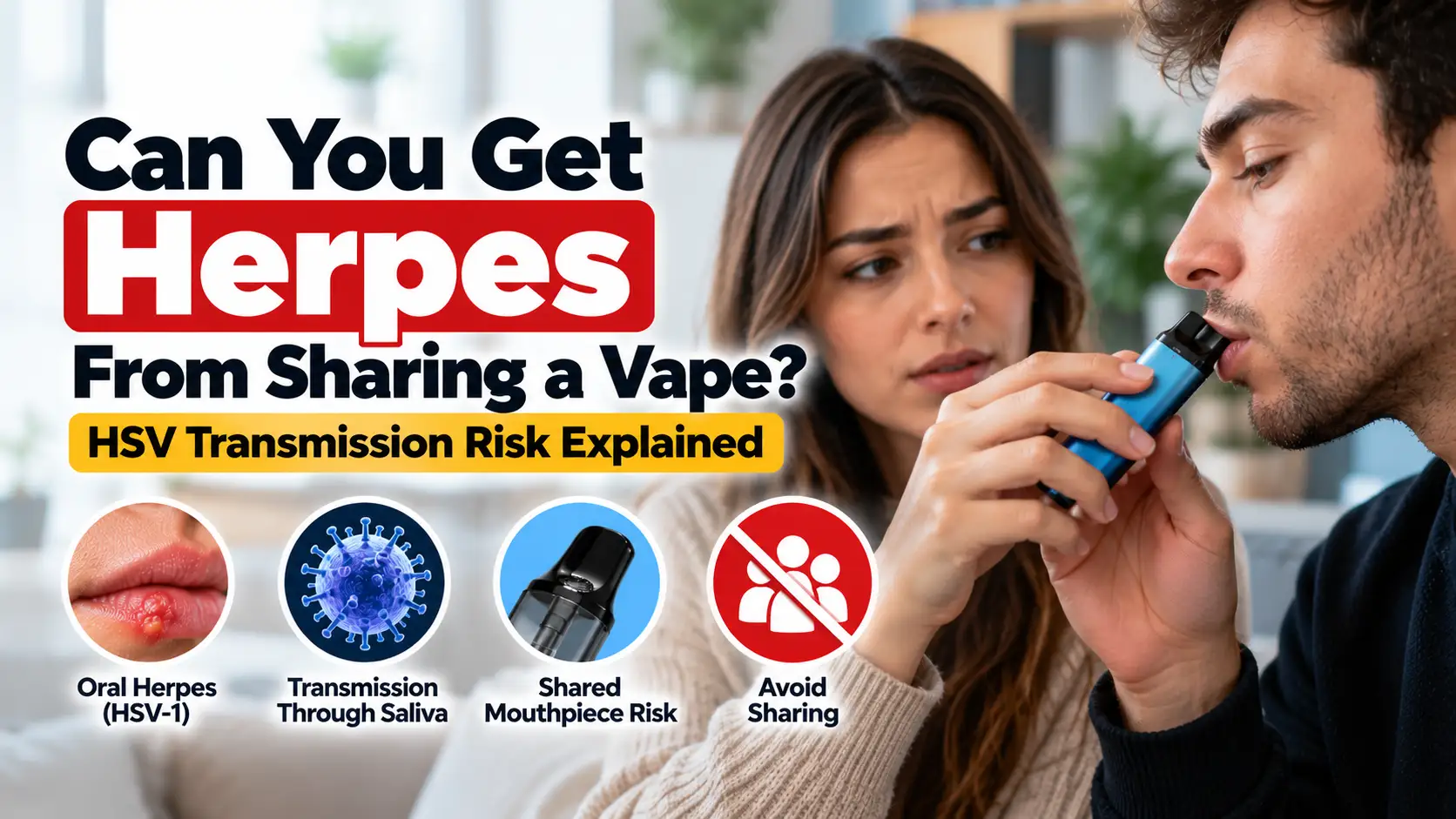
Can You Get Herpes From Sharing a Vape? HSV Transmission Risk Explained
Sharing a vape means using a mouthpiece that has just been in contact with another person’s lips and potentially their saliva. That raises a reasonable health question, especially when cold sores or oral infections are involved.
So, can you get herpes from sharing a vape? It is biologically possible for a saliva-contaminated mouthpiece to provide an indirect route for oral HSV-1. However, herpes primarily spreads through direct contact with infected skin, sores, saliva, or oral surfaces. There is not enough evidence to assign a reliable percentage risk to a single shared-vape exposure.
The practical advice is simple: avoid sharing vape mouthpieces, particularly when someone has an active cold sore or symptoms suggesting an outbreak is developing.
Table of Contents
- Quick answer
- HSV-1 and HSV-2 explained
- How herpes spreads
- How a shared vape could transmit HSV
- HSV survival on surfaces
- Oral vs genital herpes
- Other sharing risks
- What to do after an exposure
- FAQs
Can You Get Herpes From Sharing a Vape?
Yes, transmission through a contaminated shared mouthpiece is biologically possible, particularly for HSV-1, but it is an indirect route rather than the main way herpes spreads.
HSV-1 primarily spreads through contact with the virus in sores, saliva, or skin surfaces in or around the mouth. People can also transmit HSV-1 when they have no visible symptoms.
WHO advises people with symptoms of oral herpes to avoid sharing objects that have touched saliva.
This does not mean everyone who shares a vape with someone who has HSV will become infected. Whether transmission occurs can depend on whether infectious virus is present, how recently the mouthpiece was contaminated, environmental conditions, and contact with susceptible oral tissue.
When answering can you get herpes from sharing a vape, it is therefore more accurate to say that transmission is possible than to claim a particular percentage risk.
What Is Herpes Simplex Virus?
Herpes is caused by herpes simplex virus. The two major types are HSV-1 and HSV-2.
Both can cause lifelong infections, and many people have no symptoms or symptoms mild enough to go unrecognized.
WHO estimated that about 3.8 billion people under age 50 had HSV-1 infection in 2020. HSV-1 is the main cause of oral herpes, although it can also cause genital infection.
What Is HSV-1?
HSV-1 commonly causes infection in or around the mouth. Symptoms can include cold sores, blisters or ulcers.
The virus mainly spreads through oral contact involving infected sores, saliva or skin around the mouth.
Importantly, visible cold sores are not required for transmission. Someone with HSV-1 can sometimes shed the virus even when their mouth and lips appear normal.
HSV-1 is therefore the herpes type most relevant to questions about sharing objects that touch the mouth.
What Is HSV-2?
HSV-2 primarily causes genital herpes.
It is mainly transmitted during sexual contact through infected genital or anal skin, sores or fluids. Like HSV-1, HSV-2 can also be transmitted when obvious symptoms are absent.
A vape mouthpiece is not considered a typical route for HSV-2 transmission.
It is also important not to confuse virus type with infection location. HSV-1 can cause genital herpes, particularly following oral-genital contact.
How Does Herpes Normally Spread?
Understanding normal HSV transmission helps put sharing a vape risks into perspective.
Herpes spreads primarily through close contact with infected skin, sores, saliva or mucosal surfaces.
For oral HSV-1, direct oral contact is an important route. HSV-2 is predominantly sexually transmitted.
The virus does not require a visible blister to spread.
What Is Asymptomatic Viral Shedding?
Viral shedding occurs when HSV is present on skin or mucosal surfaces and can potentially be transmitted.
The Public Health Agency of Canada explains that HSV can be contagious without visible signs or symptoms because asymptomatic viral shedding occurs.
Transmission risk is higher around prodromal symptoms and outbreaks, but normal-looking skin does not guarantee that no virus is being shed.
That makes it unreliable to decide whether sharing a mouth-contact object is safe simply by checking whether someone has a visible cold sore.
How Could Sharing a Vape Transmit HSV-1?
The possible route is relatively straightforward.
One person places their lips around the vape mouthpiece. Saliva or material from the lip area may be deposited on that surface. Another person then places the same mouthpiece against their own lips or mouth.
This is indirect contact through a contaminated object, sometimes described as fomite transmission.
If you are researching can you get herpes from sharing a vape, this is the plausible mechanism. It does not mean vaping itself produces or causes herpes.
The potential concern is the shared mouthpiece, not the vapour or aerosol coming from the device.
If you are unfamiliar with the parts that come into contact with the mouth, our guide to what a vape looks like explains common device components and formats.
Does an Active Cold Sore Increase Concern?
Yes.
WHO states that HSV-1 is most contagious when active sores are present, although transmission can also occur when symptoms are absent.
Someone with a visible cold sore or oral lesion should avoid sharing objects that come into contact with their mouth.
The same precaution makes sense when someone experiences warning symptoms such as tingling, itching or burning around an area where cold sores normally appear.
Can Herpes Survive on a Vape Mouthpiece?
This is where the original article needs an important correction.
There is not strong clinical evidence establishing exactly how long infectious HSV survives on a real vape mouthpiece during normal use.
However, laboratory research shows that HSV-1 can remain viable on some contaminated objects and surfaces.
Research involving toothbrushes and other objects found replication-competent HSV-1 after contamination, although the amount declined substantially over time. Other laboratory research has recovered infectious HSV from plastic and other surfaces.
A 2023 study also found HSV-1 could persist on several food-related surfaces under experimental conditions.
These studies demonstrate that HSV does not necessarily become harmless immediately after contacting an object.
They do not establish how frequently people acquire herpes by sharing vapes.
Does Waiting for the Mouthpiece to Dry Make It Safe?
There is no evidence-based number of seconds or minutes after which a shared vape mouthpiece can be declared safe.
Laboratory research indicates that drying and environmental conditions can affect viral survival. However, infectious HSV has still been recovered from contaminated surfaces under some experimental conditions.
Therefore, advice such as “wait a few minutes and the virus will die” is not reliable.
Using a separate mouthpiece is a more dependable precaution.
Can You Get Oral Herpes From Sharing a Vape?
This is the more relevant form of herpes when discussing mouthpiece sharing.
HSV-1 commonly causes oral herpes and can spread through contact involving saliva and oral surfaces.
Therefore, oral herpes from sharing a vape is biologically plausible if infectious material contaminates a mouthpiece and subsequently reaches another person’s mouth.
However, major public-health guidance emphasizes direct oral and skin contact as the primary transmission routes.
There is currently insufficient evidence to calculate the chance of acquiring HSV-1 from one shared-vape event.
This distinction matters. Saying transmission is possible is scientifically defensible. Saying a person has a specific percentage chance after sharing a vape is not.
Can You Get Genital Herpes From Sharing a Vape?
This question requires a different answer.
HSV-2, the main cause of genital herpes, spreads primarily through sexual contact. Sharing a vape is not a recognized typical route for genital HSV-2 infection.
HSV-1 can also cause genital herpes, but this usually happens when oral HSV-1 is transmitted to the genital area through oral-genital contact.
Simply sharing a vape does not transfer virus from the mouthpiece to the genital area.
The shared-vape question should therefore be treated primarily as a possible oral HSV-1 exposure, not as a normal route for acquiring genital herpes.
What Are the Other Risks of Sharing a Vape?
Herpes is not the only reason to avoid sharing something that repeatedly touches another person’s mouth.
Different respiratory and saliva-associated infections have different transmission routes. Depending on the organism, infection may spread through close contact, respiratory particles, saliva, contaminated hands or objects.
It would be inaccurate to claim that every cold, influenza infection, mononucleosis case or bacterial infection is proven to spread specifically through vape sharing.
The broader hygiene principle is simpler: sharing a mouth-contact item unnecessarily exposes another person to oral secretions.
People share vaping products for many social and practical reasons. Our article explaining why people vape covers some of the broader motivations behind vaping behaviour.
How to Reduce Herpes and Infection Risk When Vaping
If you are concerned about can you get herpes from sharing a vape, the easiest precaution is also the most effective practical one: do not share the mouthpiece.
Use your own device or a separate personal mouthpiece.
Avoid sharing when someone has a visible cold sore, unexplained lip lesion, or early symptoms such as tingling or burning around the lips.
Cleaning removable mouthpieces according to the manufacturer’s instructions is sensible general hygiene, but cleaning should not be described as a guarantee against HSV transmission.
Do not put alcohol, water or other cleaning products into batteries, electronic components or airflow systems unless the device manufacturer specifically says that cleaning method is safe.
What Should You Do After Sharing a Vape?
If you have already shared a vape, do not assume that infection occurred.
Even when an exposure is biologically possible, exposure and infection are not the same thing.
Watch for symptoms and speak with a healthcare professional if suspicious lesions appear or if you have a particular reason to be concerned.
Symptoms of Oral Herpes
Oral herpes can cause:
- Tingling, itching or burning around the lips
- Small blisters
- Painful sores or ulcers
- Crusting as lesions heal
- Swollen lymph nodes
- Fever, headache or body aches during some first infections
Many HSV infections are asymptomatic or mild.
These symptoms are also not unique to herpes. A lip lesion should not automatically be diagnosed as HSV based only on appearance.
When Should You Get Tested for Herpes?
Testing depends on symptoms and circumstances.
If a fresh blister or sore develops, a healthcare professional can take a sample from the lesion. CDC guidance notes that tests using samples from active sores work best before lesions have crusted or begun healing.
Blood testing is different.
CDC does not recommend routine herpes blood screening for most people without symptoms because the tests have limitations, including the possibility of false-positive results in people at relatively low risk.
A herpes blood test also cannot tell you exactly when you acquired HSV or identify who transmitted it.
If a suspicious lesion appears following a possible exposure, contacting a healthcare professional while the lesion is still fresh may make diagnostic testing more useful.
How Is Herpes Treated?
There is currently no treatment that eliminates HSV from the body completely.
Antiviral medicines can help manage infections and outbreaks.
Common antiviral medicines used for herpes include acyclovir, valacyclovir and famciclovir.
Depending on the circumstances, treatment can shorten or reduce outbreaks. Suppressive antiviral therapy can also reduce recurrences and lower transmission risk in relevant settings.
Treatment depends on factors such as the location and type of infection, symptoms, medical history and recurrence pattern.
A healthcare professional can determine whether antiviral treatment is appropriate.
Frequently Asked Questions
Can You Get Herpes From Sharing a Vape Pen?
Yes, indirect HSV-1 transmission through a contaminated mouthpiece is biologically possible. However, there is no reliable percentage risk for a single vape-sharing event, and direct oral or skin contact remains the main transmission route.
Can You Get Herpes From Sharing a Vape Without a Cold Sore?
It is possible because HSV can be shed when no visible symptoms are present. Active sores generally represent a higher-risk period, but their absence does not establish zero risk.
Can You Get HSV From a Vape?
A vape does not create HSV. The relevant concern is whether its mouthpiece becomes contaminated with infectious oral material and is then shared.
Can You Get Herpes From Smoking After Someone?
Sharing another item that directly contacts the mouth raises a similar indirect-contact concern. WHO advises people experiencing oral-herpes symptoms not to share objects that have touched saliva.
Does Vaping Cause Cold Sores?
Vaping does not cause HSV infection. A person must first acquire herpes simplex virus.
Evidence is also insufficient to claim broadly that vaping itself is a proven trigger for herpes outbreaks. Irritation around the lips after vaping should not automatically be assumed to be herpes.
Editorial & Health Note
This article is for general informational purposes and is not medical advice. Health-related claims are researched under our Health & Safety Editorial Standards and Fact Checking policy. We only describe an article as medically reviewed when a qualified reviewer actually reviewed it and is identified.