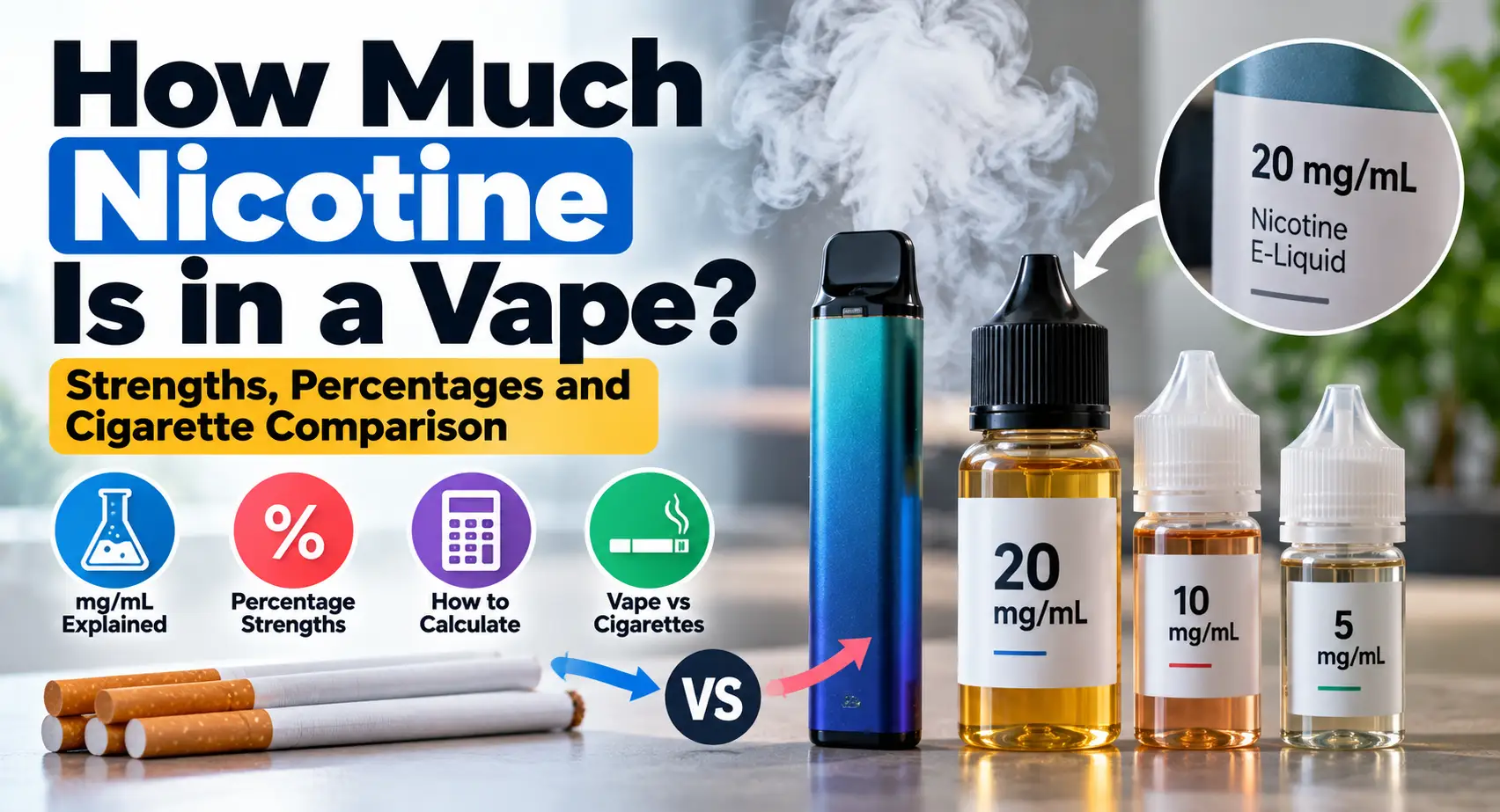
How Much Nicotine Is in a Vape? Strengths, Percentages and Cigarette Comparison
A vape labelled 20 mg/mL does not necessarily contain 20 mg of nicotine in total. That number describes the nicotine concentration in each millilitre of e-liquid. To calculate the amount in a device or bottle, you also need to know how much liquid it contains.
So, how much nicotine is in a vape? The answer depends on its labelled strength and e-liquid volume. A 2 mL device containing 20 mg/mL liquid holds 40 mg of nicotine in total, while a 10 mL bottle at the same strength holds 200 mg.
Neither figure tells you how much nicotine a person actually absorbs. This guide explains the calculations, common strengths, Canadian rules and why comparisons with cigarettes require care.
Table of Contents
- How nicotine strength is measured
- How to calculate total nicotine
- Common nicotine strengths
- Nicotine salts vs freebase
- Canadian nicotine limits
- Vape nicotine vs cigarette nicotine
- Why puff comparisons are unreliable
- Recognizing excessive nicotine exposure
- Frequently asked questions
How Is Nicotine Strength Measured in a Vape?
Nicotine labels commonly use milligrams per millilitre (mg/mL). Some products and international listings also show percentages.
Understanding the unit is important because concentration and total nicotine are not interchangeable.
What Does 20 mg/mL Mean?
A liquid labelled 20 mg/mL contains 20 milligrams of nicotine in each millilitre of liquid.
It does not mean the entire device contains only 20 mg.
For example, a 2 mL product at this concentration contains twice as much total nicotine as a 1 mL product at the same concentration.
What Do 2% and 5% Nicotine Mean?
In conventional vape-strength labelling, the commonly used approximate conversions are:
| Labelled Strength | Approximate Concentration |
|---|---|
| 0% | 0 mg/mL |
| 0.3% | 3 mg/mL |
| 0.6% | 6 mg/mL |
| 1% | 10 mg/mL |
| 2% | 20 mg/mL |
| 5% | 50 mg/mL |
These are standard industry shorthand conversions. A percentage label alone should not replace checking the actual mg/mL declaration, especially because percentage conventions and labelling requirements can differ between markets.
In Canada, nicotine-containing vaping products must display their nicotine concentration in mg/mL.
How Much Nicotine Is in a Vape? Calculate the Total Amount
The basic calculation is straightforward:
Nicotine concentration (mg/mL) × e-liquid volume (mL) = total nicotine (mg)
The result describes the nicotine contained in the liquid, not the amount delivered into the bloodstream.
Example 1: A 2 mL Vape at 20 mg/mL
20 mg/mL × 2 mL = 40 mg total nicotine
Example 2: A 10 mL Bottle at 20 mg/mL
20 mg/mL × 10 mL = 200 mg total nicotine
Example 3: A 5 mL Device at 5%
Using the conventional 5% ≈ 50 mg/mL conversion:
50 mg/mL × 5 mL = 250 mg total nicotine
The third example illustrates a strength used in some international markets. It is not a compliant nicotine concentration for an ordinary vaping product manufactured or imported for sale in Canada.
Quick Nicotine Content Table
| E-Liquid Volume | 3 mg/mL | 6 mg/mL | 12 mg/mL | 20 mg/mL |
|---|---|---|---|---|
| 1 mL | 3 mg | 6 mg | 12 mg | 20 mg |
| 2 mL | 6 mg | 12 mg | 24 mg | 40 mg |
| 5 mL | 15 mg | 30 mg | 60 mg | 100 mg |
| 10 mL | 30 mg | 60 mg | 120 mg | 200 mg |
All figures represent nicotine contained in the liquid. They are not estimates of absorbed nicotine.
For more background on common hardware formats, see the VapeAnswers guide to what a vape looks like.
Vape Nicotine Levels Explained
Products are sold in different strengths because their formulations and intended device types vary.
Commonly encountered label values include 0, 3, 6, 12 and 20 mg/mL. Higher concentrations, including approximately 50 mg/mL, appear in some international markets.
However, calling a strength “light,” “moderate” or “strong” without considering the device can be misleading.
A high-output device using a lower-concentration liquid may deliver substantial nicotine. A low-output device using a higher concentration can produce a different exposure pattern.
Nicotine delivery depends on more than the number printed on the bottle.
Does 0 mg/mL Mean Nicotine-Free?
A 0 mg/mL label indicates that a product is intended to contain no nicotine.
In Canada, specific labelling requirements apply to nicotine-free declarations. Health Canada can test products when their declared nicotine content is in question.
Nicotine Salts vs Freebase Nicotine
Freebase nicotine and nicotine salts are different formulations used in e-liquids.
Freebase formulations are often associated with a more noticeable throat sensation at higher concentrations. Nicotine salt formulations can have different acidity and sensory characteristics, allowing some products to feel less harsh at a given concentration.
However, a smoother sensation does not mean the liquid contains less nicotine or presents no addiction risk.
Two products labelled 20 mg/mL have the same stated nicotine concentration regardless of whether one uses nicotine salts and the other uses freebase nicotine.
Their actual nicotine delivery can still differ because of device design and user behaviour.
What Is the Maximum Nicotine Strength in Canada?
Canada’s federal Nicotine Concentration in Vaping Products Regulations establish a maximum of 20 mg/mL for vaping products manufactured or imported for sale in Canada.
The regulations came into force on July 8, 2021. The rules also prohibit packaging or selling a product whose displayed nicotine concentration exceeds the limit.
This is a concentration limit, not a limit of 20 mg of nicotine per entire device.
For example, a 10 mL bottle at 20 mg/mL contains 200 mg in total while remaining at the maximum permitted concentration.
A 5% product labelled approximately 50 mg/mL exceeds that Canadian limit. Product availability and regulations in other countries should not be assumed to apply in Canada.
How Much Nicotine Is in a Cigarette?
To compare smoking and vaping, it helps to separate the nicotine present in tobacco from the amount a smoker absorbs.
A cigarette contains substantially more nicotine in its tobacco than typically enters the smoker’s bloodstream.
Research commonly describes nicotine intake from smoking one cigarette as approximately 1–2 mg, although the amount varies with the cigarette and smoking behaviour.
That estimate refers to intake, not the total nicotine physically present in the tobacco.
How Much Nicotine Does a Pack Deliver?
Using the approximate intake range:
20 cigarettes × 1–2 mg = 20–40 mg absorbed nicotine
This is an illustrative range for a pack of 20 cigarettes, not a guaranteed dose for every smoker.
It should not be compared directly with the total nicotine remaining in a bottle of e-liquid.
How Many Cigarettes Equal One Vape?
This question does not have a universal numerical answer.
Consider a 2 mL device at 20 mg/mL. It contains 40 mg of nicotine in its liquid.
Dividing that 40 mg by an estimate of 1.5 mg absorbed per cigarette would produce a number, but the result would compare total nicotine in a vape with absorbed nicotine from smoking.
Those measurements are fundamentally different.
Why the Calculation Is Misleading
Not all nicotine in a vaping device reaches the person using it.
Some liquid may remain unused. Nicotine delivery also changes with aerosol production, puff duration, inhalation behaviour and device characteristics.
The appropriate comparison would require measurements of actual nicotine intake under specified conditions, rather than simply dividing two label values.
This is why a claim such as “one disposable equals 27 cigarettes” cannot be established from e-liquid strength and capacity alone.
Can a Vape Contain More Total Nicotine Than a Pack?
Yes, depending on its liquid volume and concentration.
But that observation concerns the amount stored in the product. It does not establish equivalent nicotine absorption, addiction potential or overall health effects.
For a separate look at product categories and costs, read How Much Do Vapes Cost in Canada?
How Many Vape Puffs Equal One Cigarette?
There is no reliable universal puff conversion.
A cigarette may be smoked in a relatively short session, while vaping can involve intermittent use throughout the day. Two people using the same device may take puffs of different lengths and volumes.
Research shows that nicotine delivery varies with:
- Nicotine concentration
- Device power and design
- Puff duration and volume
- Frequency of use
- User experience and inhalation behaviour
Studies have also found that experienced users of some e-cigarette products can achieve nicotine blood-level increases comparable to cigarette smoking. This does not mean every vape or every puff delivers the same amount.
Why Advertised Puff Counts Do Not Help
A disposable labelled with thousands of puffs does not provide a dependable cigarette-equivalence figure.
Advertised puff counts depend on testing assumptions, while real-world use differs between people.
A puff count tells you neither the exact nicotine absorbed per puff nor how many cigarettes the device replaces.
Vape vs Cigarettes: Which Delivers More Nicotine?
The answer depends on the product and the way it is used.
Cigarettes can deliver nicotine rapidly. Modern e-cigarettes can also produce substantial nicotine exposure, particularly in experienced users.
A review of nicotine delivery research found considerable variation across devices, concentrations and vaping patterns. Some experienced users achieved blood nicotine levels comparable to cigarette users.
This is why neither “vapes always deliver less nicotine” nor “every vape contains several packs’ worth of nicotine” is an accurate general conclusion.
The health comparison also involves more than nicotine. Burning tobacco creates combustion-related toxicants, while vaping aerosol has a different chemical profile and is not harmless.
How Can You Recognize Excessive Nicotine Exposure?
The amount on a label cannot predict an individual’s response.
Symptoms associated with excessive nicotine exposure can include nausea, dizziness, headache, sweating, vomiting and a rapid heartbeat.
More serious poisoning can involve confusion, weakness, breathing difficulties or other severe symptoms.
Stop using the product if concerning symptoms occur. Seek urgent medical advice for severe symptoms or suspected poisoning.
Keep E-Liquid Away From Children
Nicotine-containing liquid can be poisonous if swallowed or absorbed through the skin. Young children are particularly vulnerable.
Keep products securely closed, out of sight and reach of children and pets. Do not transfer e-liquid into food or drink containers.
In Canada, suspected nicotine-liquid poisoning requires prompt medical attention or contact with a poison control centre.
What About Cravings and Withdrawal?
Irritability, restlessness and cravings can occur with nicotine withdrawal. However, these symptoms are not a reliable method for calculating the concentration or dose a person needs.
Anyone seeking to stop smoking or reduce nicotine dependence can discuss evidence-based cessation options with a qualified healthcare professional.
The VapeAnswers article on why people vape provides additional context about nicotine dependence and other reasons people use these products.
Frequently Asked Questions
How Much Nicotine Is in a 2 mL Vape?
At 20 mg/mL, a 2 mL device contains 40 mg of nicotine in total.
The amount absorbed depends on how the product is used.
How Much Nicotine Is in a 5% Vape?
A conventional 5% label represents approximately 50 mg/mL. Multiply that concentration by the liquid volume to estimate total nicotine.
This concentration exceeds Canada’s federal 20 mg/mL limit for ordinary vaping products manufactured or imported for sale.
Is 20 mg Nicotine the Same as 20 mg/mL?
No. Twenty milligrams describes an amount, while 20 mg/mL describes concentration.
A 5 mL bottle at 20 mg/mL contains 100 mg of nicotine in total.
Does One Vape Equal a Pack of Cigarettes?
There is no universal equivalence. Total nicotine content and absorbed nicotine are different measurements.
Does a Higher Puff Count Mean More Nicotine?
Not necessarily. Puff count alone does not establish liquid concentration, total nicotine content or absorbed dose.
Editorial & Health Note
This article is for general informational purposes and is not medical advice. Health-related claims are researched under our Health & Safety Editorial Standards and Fact Checking policy. We only describe an article as medically reviewed when a qualified reviewer actually reviewed it and is identified.