Why Do People Vape?
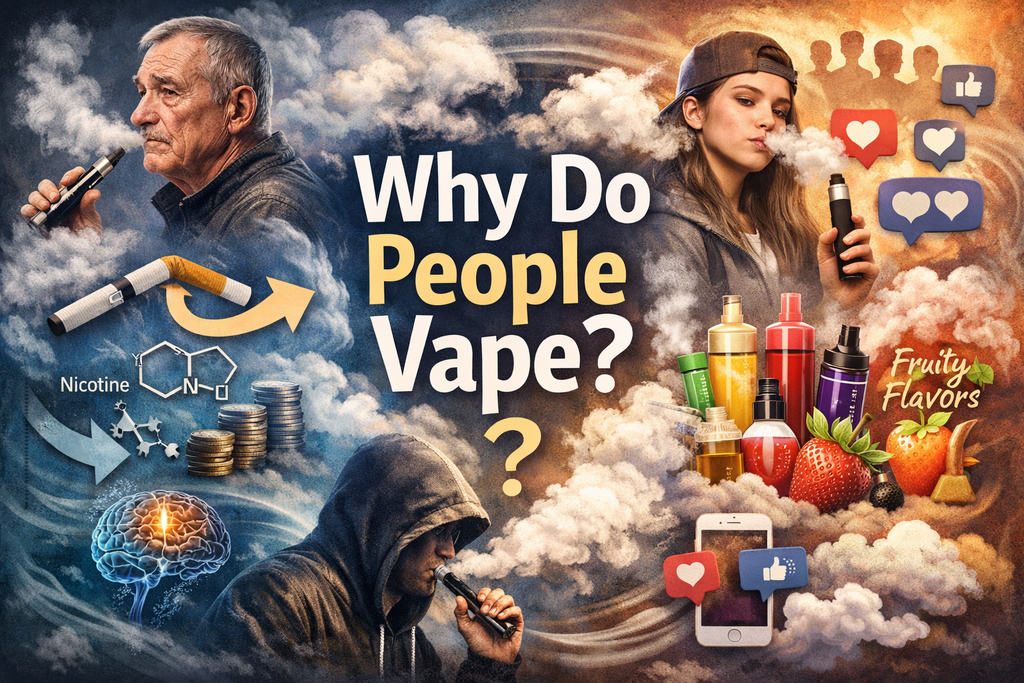
Vaping is often framed as a simple decision: a person either vapes because they are trying to quit smoking, or they vape because it looks trendy. In reality, the motivations behind vaping are far more intricate.
For some, vaping is a harm-reduction tool. For others, it is a social accessory. For many, it becomes a quiet dependency that sneaks in through curiosity, flavours, and convenience.
Understanding why people vape means looking beyond stereotypes and examining biology, psychology, economics, and culture because vaping sits at the intersection of all four.
Table of contents
Vaping Isn’t One-Size-Fits-All
Vaping is the act of inhaling aerosol produced by an electronic device (an e-cigarette or vape) that heats a liquid often containing nicotine, flavourings, and other chemicals.
Unlike cigarettes, vaping does not involve combustion. That distinction matters. Burning tobacco produces tar and thousands of byproducts. Vaping creates an aerosol instead of smoke.
Vapes also come in many different forms, from disposable devices and vape pens to pod systems and larger mods. If you are unfamiliar with them, see our guide explaining what a vape looks like.
But the reason people vape is rarely about chemistry alone.
People vape because it offers something cigarettes don’t: customization, convenience, concealability, and a vast sensory menu of flavours and nicotine strengths. It can feel like a controlled habit. A modernized vice. A sleek workaround.
And that perception whether accurate or not is one of the biggest drivers of vaping adoption.
Swapping Cigarettes for Vape (Smoking Cessation & Harm Reduction)
One of the most common reasons people vape is straightforward: they are trying to stop smoking.
Traditional smoking is notoriously difficult to quit, not only because nicotine is addictive, but because smoking is also deeply habitual. It becomes a daily ritual after meals, during stress, while driving, while socializing. It’s a behavioural groove worn into the nervous system.
Vaping offers an alternative that preserves the ritual while removing the combustion. That is the key psychological advantage.
Why smokers switch to e-cigarettes
Many smokers report switching because vaping can:
- Reduce exposure to the toxins created by burning tobacco
- Feel less harsh on the throat than cigarettes
- Smell less offensive to others
- Be used in more settings
- Offer nicotine in adjustable strengths
The role of habit and hand-to-mouth behavior
Nicotine addiction is chemical. Smoking addiction is chemical and behavioural.
Vaping replicates the “hand-to-mouth” routine and the inhalation ritual, which can be more psychologically reinforcing than nicotine patches or gum.
Why quitting cold turkey often fails
Nicotine withdrawal can create:
- irritability
- restlessness
- insomnia
- concentration issues
- anxiety spikes
So while “cold turkey” works for some, many people relapse repeatedly. Vaping becomes the compromise an intermediate step that feels survivable.
3) What Are the Main Reasons for Vaping?
Even beyond quitting smoking, there are many reasons people vape. Some are practical. Some are emotional. Some are cultural.
Curiosity and experimentation
A large number of people especially young try vaping for one reason: curiosity.
Vapes are marketed and discussed like gadgets, not drugs. They look harmless. They taste sweet. They produce fun clouds. They seem low-risk.
So experimentation feels casual. Almost playful.
Cost-cutting vs cigarettes
Another common reason people vape is financial.
In many places, cigarettes are heavily taxed and extremely expensive. Vaping is often perceived as cheaper, especially with refillable devices.
Even when vaping costs add up over time, the immediate price difference can feel like a strong incentive.
Flavours and sensory appeal
Flavours are not a minor feature. They are a central psychological hook.
Vaping is not just nicotine delivery it is a sensory experience:
- sweetness
- cooling menthol effects
- dessert profiles
- fruit blends
- candy-like aftertastes
For many people, the flavour becomes the reason. Nicotine becomes secondary.
Tech appeal: devices, customization, and “cool factor”
Vaping has a technological aura.
Many devices feel like personal electronics: sleek, rechargeable, minimalist. Others are highly customizable, with adjustable airflow, wattage, and coil setups.
For some users, vaping is as much about the device as the nicotine. The product design itself becomes part of the attraction.
Marketing and social normalization
People vape because they see other people vape.
That sounds obvious, but it matters. Social proof is one of the most powerful forces in human behaviour. When vaping appears normalized especially in social circles trying it feels less like a risk and more like a rite of passage.
Appetite suppression and weight-control myths
Nicotine can suppress appetite.
However, vaping for weight control is a risky and often unspoken motivator. It can lead to dependency patterns, especially in individuals vulnerable to body-image pressure.
The danger is that vaping becomes not a “habit,” but a compensatory behaviour.
Mental health coping and emotional regulation
Some people vape because it gives them a temporary psychological buffer.
Not a cure. Not a solution. A pause.
The inhalation ritual, the throat hit, the nicotine rush these can momentarily distract from:
- stress
- depression
- low self-esteem
- social anxiety
- emotional overwhelm
The problem is that the relief is short-lived. And repeated use can create a cycle where stress triggers vaping, and vaping increases dependence, which creates more stress.
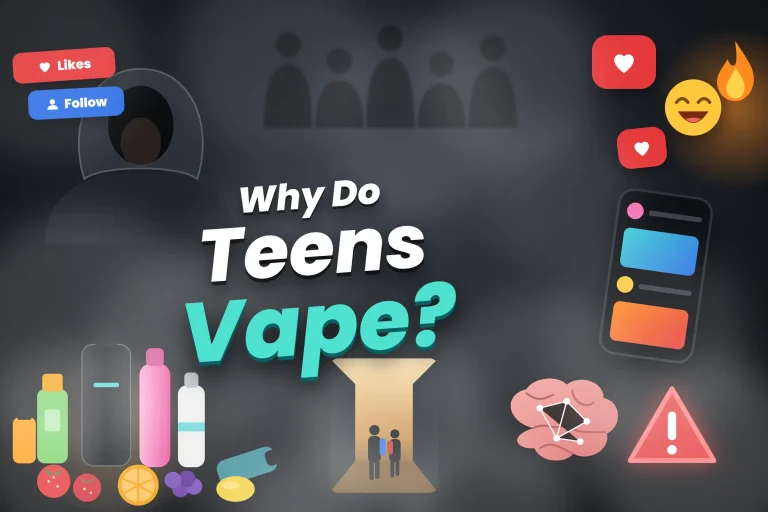
Why Do Young People Vape?
The question “why do teens vape?” is not separate from “why do people vape.” It is the same question just intensified by adolescent psychology.
Teen brains are more sensitive to novelty and reward. They are also more vulnerable to addiction pathways.
Peer pressure and social identity
Teenagers don’t just want to fit in. They want to belong.
Vaping can become a symbol:
- of being older
- of being rebellious
- of being “in the know”
- of being part of a group
Even when teens don’t feel directly pressured, social imitation still happens.
Boredom and stimulation seeking
A surprising number of young people vape because they are bored.
Vaping becomes a quick micro-stimulation:
- a small buzz
- a small ritual
- a small “event” in the day
It is a pocket-sized dopamine lever.
Curiosity + easy availability
Many young people start vaping simply because it is accessible.
If a product is everywhere, visible, cheap, and socially normalized, the barrier to trying it collapses.
Flavours, packaging, and youth aesthetics
Bright colours. Sweet flavours. Fun names.
Even when a company claims adult targeting, the visual language often overlaps with youth appeal. Packaging can feel like candy branding.
That aesthetic makes vaping seem harmless and that perception drives initiation.
Social media and influencer culture
Vaping is not only consumed. It is performed.
Cloud tricks, device reviews, “aesthetic” vape shots, and influencer normalization all contribute to vaping as a cultural object.
Key Factors Behind Underage Vaping
Underage vaping is not driven by one single factor. It is a convergence.
Experimentation as the #1 trigger
Most teens who try vaping do so because they want to see what it feels like.
They aren’t always trying to get addicted. They are trying to satisfy curiosity.
But nicotine does not require intention. It only requires exposure.
Taste as a gateway
Taste is one of the most underestimated drivers.
Sweet flavours reduce harshness. They make vaping easier to inhale. They make it feel like a treat, not a drug.
That matters.
Illicit sales and access loopholes
Even where laws exist, enforcement gaps allow underage access:
- proxy buying
- online loopholes
- informal resale
- unregulated imports
Schools and other facilities may also use monitoring technology to identify vaping in difficult-to-supervise areas. Our guide to what vape detectors look like explains the devices commonly seen in school bathrooms and other indoor spaces.
Why bans and restrictions are increasing
Many governments are tightening rules because disposable vapes and high-nicotine products have raised concerns about youth uptake.
Policy tends to follow patterns. When youth use rises, regulation escalates.
Is Vaping a Safer Alternative to Smoking?
This is one of the most searched questions in vaping.
Vaping is generally discussed as a harm-reduction alternative for people who already smoke and switch completely.
Combustion vs aerosol: what changes biologically
Cigarettes burn tobacco. That produces tar, carbon monoxide, and a massive chemical load.
Vapes heat liquid to create aerosol. That removes combustion, which is where many of the worst toxicants come from.
The harm-reduction appeal
For smokers, vaping can be an off-ramp.
Not a health product. Not a vitamin. But potentially a less damaging alternative than continued smoking.
What is still unknown
Vaping is relatively new compared to cigarettes.
Long-term population-level effects are still being studied. This uncertainty makes vaping a complex public health issue: it may reduce harm for smokers, while increasing harm if it attracts non-smokers.
Is Nicotine Addiction a Key Reason People Vape?
Yes. For many people, nicotine is the engine.
Nicotine is one of the most habit-forming substances commonly used in daily life. It acts quickly. It reinforces behaviour rapidly. It becomes tied to routine.
Why nicotine is uniquely habit-forming
Nicotine triggers dopamine release in reward circuits. That creates:
- reinforcement
- craving
- habit consolidation
Over time, the brain starts expecting nicotine during certain moments: stress, boredom, socializing, breaks, after meals.
Nicotine salts vs freebase nicotine
Modern vapes often use nicotine salts, which can deliver nicotine more smoothly and at higher concentrations with less throat irritation.
That means it can be easier to consume more nicotine without realizing it.
Why “nicotine-free” vaping still hooks some people
Even without nicotine, vaping can still become habitual because:
- the ritual is reinforcing
- flavours create sensory reward
- inhalation becomes a coping routine
Nicotine addiction is not the only form of dependency.
Does Vaping Increase Anxiety?
Vaping is often used to calm down. Ironically, nicotine can contribute to anxiety over time.
The rebound effect
Nicotine can create a cycle:
- Stress rises
- Person vapes
- Temporary relief occurs
- Nicotine levels drop
- Withdrawal symptoms mimic anxiety
- Person vapes again
So vaping can feel like anxiety relief, while actually training the nervous system into a dependency loop.
Why vaping feels calming (temporarily)
The calming effect can come from:
- controlled breathing
- ritual repetition
- dopamine release
- distraction from stressful thoughts
But the effect fades quickly.
The stress-addiction loop
This is where many people get stuck.
They don’t vape because they want to. They vape because their brain has learned it is the fastest way to feel normal again.
The Psychology of Vaping: Why It Feels So Compelling
Vaping is not only chemical. It is behavioural design.
Dopamine, reinforcement, and micro-rewards
Each puff can be a micro-reward.
It’s quick. It’s accessible. It doesn’t require effort. That makes it a perfect reinforcement machine.
Identity signaling and belonging
People also vape to communicate something:
- independence
- maturity
- style
- rebellion
- belonging
Humans are social creatures. We often adopt behaviours that match our group.
The comfort of small rituals
Many vapers describe vaping as “something to do.”
That matters more than it sounds.
A small ritual can become emotional scaffolding. A pause button. A momentary sanctuary.
Why Some People Vape Even If They Never Smoked
This is one of the most important public health concerns.
Some people start vaping without ever being smokers. Why?
Social initiation
Vaping often begins socially:
- at parties
- with friends
- during school breaks
- in shared spaces
The first puff is rarely planned. It’s offered.
Misconceptions about safety
Many people assume vaping is harmless because it is not smoke.
That assumption can lead to experimentation. And experimentation can lead to dependence.
Flavours as the entry point
For non-smokers, flavour is often the gateway.
If something tastes like mango ice or strawberry candy, the brain does not categorize it as dangerous. It categorizes it as enjoyable.
That is a powerful misclassification.
Frequently Asked Questions
Are vapes addictive?
If they contain nicotine, yes.
Nicotine is addictive. Even low use can build dependence in some people, especially teenagers.
Does vaping get you high?
Standard nicotine vapes do not produce a “high” like cannabis.
However, nicotine can create a buzz especially for new users which can feel stimulating, lightheaded, or euphoric for a short time.
How do teens get vapes?
Common pathways include:
- friends who buy them
- older siblings
- online loopholes
- informal resale
- unregulated sellers
Access is one of the biggest predictors of teen vaping rates.
Conclusion
People vape for many reasons, and those reasons often overlap.
Some vape to quit smoking. Some vape because it is cheaper. Some vape because it is fashionable. Others vape because it gives them a brief escape from stress, sadness, or anxiety.
The most honest answer to “why do people vape?” is this:
Vaping is a modern behaviour shaped by harm reduction, consumer design, social influence, and nicotine biology all at once.
For smokers, vaping may function as a transitional tool away from cigarettes. For young people and non-smokers, it can be an unnecessary entry point into nicotine dependence.
Understanding the motivations behind vaping is not about judgment. It is about clarity.
Because the more clearly vaping is understood, the easier it becomes to prevent harm, support quitting, and reduce addiction without ignoring the real human reasons people start in the first place.
For more evidence-focused articles about nicotine, vaping effects, addiction, explore the Health & Effects section on VapeAnswers.
Editorial & Health Note
This article is for general informational purposes and is not medical advice. Health-related claims are researched under our Health & Safety Editorial Standards and Fact Checking policy. We only describe an article as medically reviewed when a qualified reviewer actually reviewed it and is identified.