
Can You Get Second-Hand Smoke From a Vape? Health Risks Explained
When someone vapes nearby, the visible cloud may disappear within seconds. That does not necessarily mean the surrounding air is free from vaping-related substances. People sharing the space can inhale some of the aerosol released by the person vaping.
So, can you get second-hand smoke from a vape? Technically, e-cigarettes produce aerosol rather than tobacco smoke. However, passive exposure is possible. Exhaled aerosol can contain nicotine, fine particles and other chemicals, depending on the product and how it is used.
This guide explains what enters the air, how secondhand vaping differs from cigarette smoke, what research says about health effects and how to reduce exposure in shared spaces.
Table of Contents
- Secondhand smoke vs vape aerosol
- What is in exhaled aerosol?
- Can bystanders absorb nicotine?
- Health effects and research limitations
- Vape aerosol vs cigarette smoke
- Exposure at home, in cars and outdoors
- Canadian indoor vaping rules
- How to reduce exposure
- Frequently asked questions
Secondhand Smoke vs Secondhand Vape Aerosol
The terms are often used interchangeably, but they describe different emissions.
What Is Secondhand Cigarette Smoke?
Cigarettes burn tobacco. Secondhand smoke includes smoke exhaled by the person smoking and smoke released directly from the burning cigarette between puffs.
Combustion produces a complex mixture of harmful chemicals, including carbon monoxide and carcinogenic substances. The health risks of secondhand cigarette smoke are well established.
What Is Secondhand Vape Aerosol?
Vaping devices heat a liquid or another substance to produce an inhalable aerosol. Unlike a burning cigarette, a conventional e-cigarette does not continuously produce sidestream tobacco smoke.
Most passive exposure occurs when someone exhales aerosol into the surrounding air. That aerosol can contain substances other people inhale. It is not simply water vapour.
If you are unfamiliar with the hardware, the VapeAnswers guide to what a vape looks like explains common device categories and components.
Does the Visible Cloud Indicate Safety?
No. Appearance and smell are not reliable measures of exposure.
A cloud can become difficult to see as particles disperse, while some substances remain airborne or settle on surfaces. A pleasant flavour does not establish that the air is free from vaping-related chemicals.
What Is in Secondhand Vape Aerosol?
Composition varies according to device design, liquid ingredients, operating temperature and individual use.
Not every aerosol contains every substance listed below, and concentrations differ between products.
| Substance | Why It Matters |
|---|---|
| Nicotine | Can be inhaled and absorbed by nearby people when present. |
| PG and VG | Common ingredients that contribute to aerosol formation. |
| Fine particles | Can enter the respiratory system. |
| Carbonyl compounds | Certain compounds form when e-liquid ingredients are heated. |
| Volatile organic compounds | Some products and operating conditions produce these chemicals. |
| Metals | Materials associated with device components have been detected in some aerosols. |
Nicotine
Nicotine is addictive. Products containing nicotine can release some of it into the surrounding air through exhaled aerosol.
A person does not need to operate a vaping device to experience passive nicotine exposure.
PG, VG and Flavourings
Propylene glycol and vegetable glycerin are common e-liquid ingredients. Their use in food or other consumer products does not establish that repeatedly inhaling heated aerosol is harmless.
Likewise, a flavouring ingredient considered suitable for eating is not automatically safe to inhale.
Heating Byproducts and Metals
Research has identified compounds such as formaldehyde, acetaldehyde and acrolein in certain vaping aerosols. Metals, including nickel and lead, have also been detected in some products.
Amounts depend on device characteristics and operating conditions. It would be inaccurate to suggest every device releases identical concentrations.
Can You Get Second-Hand Smoke From a Vape and Absorb Nicotine?
The distinction between smoke and aerosol matters scientifically, but it does not eliminate passive exposure.
When someone exhales aerosol into a shared space, nearby people may inhale part of it. Research has also measured nicotine-related biomarkers in people exposed to vaping emissions.
What Is Cotinine?
Cotinine is a substance produced when the body processes nicotine. Researchers commonly measure it to investigate nicotine exposure.
A 2025 systematic review examined human studies of passive vaping exposure and found evidence of nicotine absorption among exposed non-users, while emphasizing limitations in the available research.
This demonstrates that passive exposure can occur. It does not mean every brief encounter produces the same dose or health outcome.
What Influences Exposure?
Several factors affect secondhand vape exposure:
- Frequency and duration of vaping
- Number of people vaping
- Product composition and aerosol output
- Room size and ventilation
- Distance from the person vaping
- Time spent in the shared environment
A brief outdoor encounter is not equivalent to repeated exposure in a small enclosed room.
Is Secondhand Vaping Harmful?
Current evidence supports avoiding unnecessary exposure, particularly among vulnerable groups. However, the exact long-term risks are not established with the same certainty as those of secondhand cigarette smoke.
What Research Has Found
Human studies have detected nicotine exposure among non-users and reported respiratory symptoms associated with passive vaping exposure.
These findings support concern, but observational associations do not establish that every reported symptom was caused solely by vaping aerosol.
What Remains Uncertain?
Researchers still need stronger long-term evidence about repeated exposure and outcomes such as chronic respiratory and cardiovascular disease.
Products also change over time, making it difficult to apply findings from one device or liquid to every product. Uncertainty should not be interpreted as proof of safety.
Children, Pregnancy and Respiratory Conditions
Vaping around children raises particular concerns because nicotine exposure is undesirable during development.
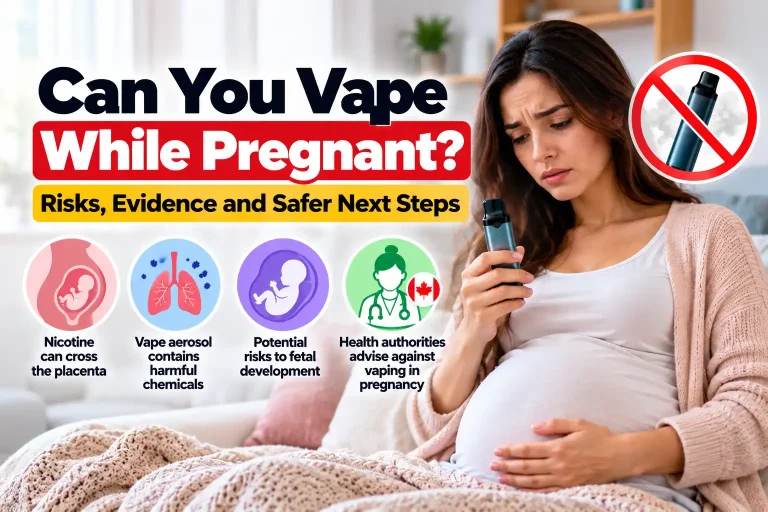
Pregnant people should also avoid unnecessary nicotine exposure. Individuals with asthma or other respiratory conditions may be sensitive to airborne irritants.
Keeping shared indoor air free from vaping emissions is a practical precaution for these groups.
Secondhand Vape vs Secondhand Cigarette Smoke
These exposures differ, and their risks should not be presented as identical.
Cigarette smoke contains products of tobacco combustion and has extensive evidence linking passive exposure to serious disease.
Vape aerosol generally contains fewer harmful chemicals than cigarette smoke. Canadian public-health guidance expects the risks of passive vaping exposure to be substantially lower than those of secondhand tobacco smoke, while acknowledging uncertainty about the precise effects.
| Comparison | Cigarette Smoke | Vape Aerosol |
|---|---|---|
| Production process | Tobacco combustion | Heating a vaping substance |
| Sidestream emissions | Released from the burning cigarette | Not produced in the same way |
| Passive exposure | Established | Documented |
| Nicotine exposure | Possible | Possible when nicotine is present |
| Long-term evidence | Extensive | Still developing |
| Harmless to bystanders | No | No |
Lower measured chemical concentrations do not make passive vaping exposure equivalent to clean air.
Where Does Secondhand Vape Exposure Happen?
The surrounding environment influences how much aerosol reaches other people.
Homes and Apartments
Repeated indoor vaping can introduce aerosol into shared living spaces. Someone in the same room may inhale emissions even after the visible cloud disappears.
Air movement between rooms can also transport airborne substances.
Cars
Cars have limited interior air volume. Vaping inside a vehicle can expose passengers, particularly when multiple puffs occur during a journey.
Opening a window may reduce concentrations, but it does not guarantee that passengers avoid exposure.
Bedrooms and Dorm Rooms
Shared bedrooms and student accommodation create similar concerns.
Aerosol enters the air used by roommates, and some vaping-related substances may deposit on indoor surfaces.
Workplaces and Public Spaces
Exposure may occur in offices, shops, shared entrances and other locations where vaping is permitted or restrictions are not followed.
Some buildings use environmental sensors to identify possible vaping activity. The VapeAnswers article on what vape detectors look like explains these devices and their appearance.
Detection technology does not replace ventilation or rules designed to protect indoor air.
Outdoors
Outdoor air generally allows emissions to disperse more readily than a small enclosed room.
Nevertheless, someone standing close to a person actively vaping may still inhale aerosol, particularly when positioned directly in the exhaled cloud.
Can Vape Residue Remain After the Cloud Disappears?
Yes. Some substances associated with vaping can be detected on indoor surfaces.
This is sometimes described as thirdhand vape residue.
Canadian public-health guidance notes evidence of increased nicotine and other chemicals on indoor surfaces where vaping occurs. The long-term health implications of contact with this residue require further research.
Is Indoor Vaping Legal in Canada?
Canadian vaping restrictions depend on the location and applicable federal, provincial, territorial and municipal rules.
Federal legislation addresses vaping in federally regulated workplaces. Other indoor public places, workplaces and shared residential spaces are generally subject to provincial, territorial and local requirements.
For example, Ontario prohibits electronic-cigarette use in enclosed workplaces, enclosed public places and specified indoor common areas of multi-unit residential buildings.
How to Reduce Secondhand Vape Exposure
The most dependable approach is to prevent vaping emissions from entering shared indoor air.
Keep Homes and Vehicles Vape-Free
Ask people who vape to do so outside, away from entrances, windows and air intakes.
This is especially relevant in homes with children, pregnant people or individuals with respiratory conditions.
Do Not Rely on Ventilation Alone
Ventilation can dilute airborne pollutants, but an open window or fan does not guarantee complete removal.
Moving air may also carry aerosol into another occupied area.
Set Clear Rules in Shared Spaces
Roommates, family members and colleagues can agree on vape-free indoor areas.
For multi-unit housing, check building rules and applicable local requirements.
People may vape for different reasons, including nicotine dependence and smoking-related motivations. Understanding why people vape can help frame a practical conversation about shared-space boundaries without assuming everyone uses these products for the same reason.
Avoid Direct Exposure Outdoors
Where possible, maintain distance from someone actively exhaling aerosol rather than standing directly in the cloud.
Frequently Asked Questions
Can Secondhand Vape Trigger Asthma Symptoms?
Vaping aerosol can contain airway irritants. People with asthma may experience symptoms around airborne irritants, although individual responses vary.
Someone experiencing wheezing or breathing difficulty should move away from the exposure and seek appropriate medical advice.
Can You Test Positive for Nicotine From Secondhand Vaping?
Passive exposure can produce measurable cotinine, a nicotine metabolite.
Whether a particular test is positive depends on exposure, test sensitivity, timing and the laboratory’s threshold.
Does Vaping in Another Room Still Affect You?
It can. Air moves between rooms through doors, ventilation systems and other openings.
The degree of exposure depends on the building and how frequently vaping occurs.
Is Secondhand Cannabis Vape Exposure Different?
Yes. Cannabis vaping products have different ingredients and may contain THC and other substances.
They should not be treated as chemically identical to nicotine e-liquids. Passive exposure can still occur, and the risk depends on the product and circumstances.
How Long Does Vape Aerosol Stay in the Air?
There is no universal duration.
Particle behaviour depends on ventilation, room size, aerosol composition and environmental conditions. A cloud becoming invisible does not prove that every substance has disappeared.
Editorial & Health Note
This article is for general informational purposes and is not medical advice. Health-related claims are researched under our Health & Safety Editorial Standards and Fact Checking policy. We only describe an article as medically reviewed when a qualified reviewer actually reviewed it and is identified.