When Did Vapes Come Out? A Timeline of Vaping History
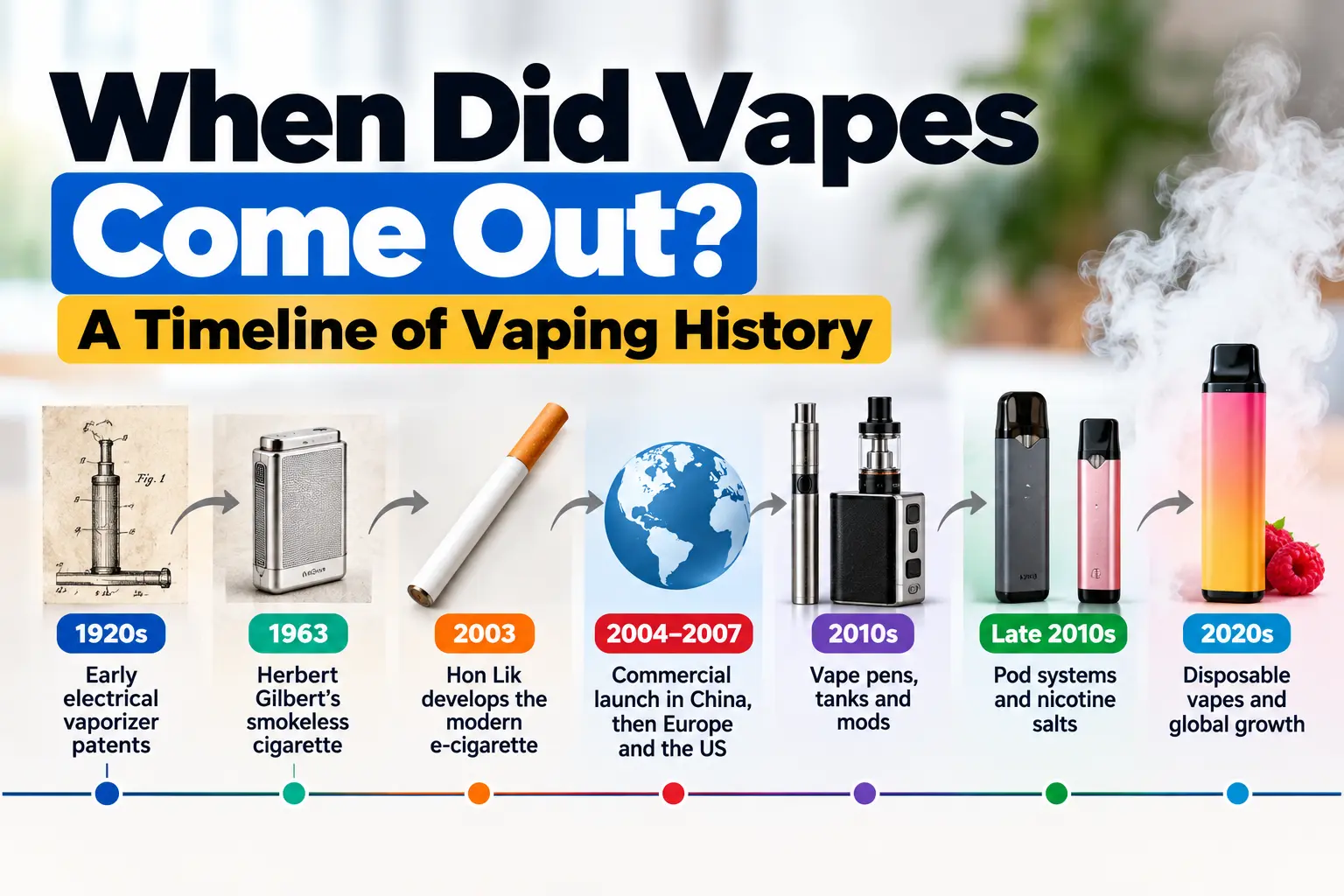
When did vapes come out? The modern e-cigarette is generally traced to 2003, when Chinese pharmacist Hon Lik developed a commercially viable electronic cigarette. It reached the Chinese market in 2004, followed by Europe around 2006 and the United States around 2007.
That is only the short answer. The history of vaping stretches back much further, including electrical vaporizers patented in the 1920s, Herbert A. Gilbert’s smokeless non-tobacco cigarette in the 1960s, and later experiments with noncombustible nicotine delivery.
This timeline explains which invention deserves to be called the first vape, when vape pens and disposables emerged, how vaping spread internationally, and the regulatory milestones that shaped today’s market.
Table of Contents
- Quick vaping timeline
- Early vaporizer patents
- Herbert Gilbert’s 1963 invention
- Hon Lik and the modern vape
- Global expansion
- Vape pens, tanks and mods
- Pod systems and nicotine salts
- Disposable vapes
- The 2019 EVALI outbreak
- Vaping regulation in Canada
- Frequently asked questions
When Did Vapes Come Out? Quick Timeline
There is no single date that captures every meaning of “vape.” Early inventors created devices for producing inhalable vapor decades before today’s electronic cigarettes existed.
For most people asking when did vapes come out, however, 2003 is the key year because it marks Hon Lik’s development of the modern e-cigarette. Commercial sales followed in China in 2004.
| Year | Vaping Milestone |
|---|---|
| 1927 | Joseph Robinson filed U.S. patent applications for electrical vaporizers intended to generate medicinal vapors for inhalation. |
| 1963 | Herbert A. Gilbert filed a patent application for a “smokeless non-tobacco cigarette.” |
| 1965 | Gilbert’s U.S. patent was granted. |
| 2003 | Hon Lik developed the modern electronic cigarette in China. |
| 2004 | The modern e-cigarette entered the Chinese market. |
| 2006 | E-cigarettes began entering European markets. |
| 2007 | E-cigarettes became available in the U.S. market. |
| Early 2010s | Vape pens, refillable tanks and customizable mods became increasingly prominent. |
| 2015 | JUUL launched in the United States, helping popularize compact pod systems and nicotine salts. |
| Late 2010s onward | Modern pod systems and disposable vapes became increasingly prominent. |
| 2019 | The U.S. EVALI outbreak triggered major public-health scrutiny. |
| 2021 | Canada’s federal 20 mg/mL maximum nicotine concentration took effect. |
The 1920s: Early Electrical Vaporizers
The history of vaping is sometimes traced to 1927 because inventor Joseph Robinson filed U.S. patent applications for electrical vaporizers.
Robinson’s inventions were designed to heat compounds and generate vapors for inhalation, particularly for medicinal purposes. A patent application filed in May 1927 described an electrical vaporizer that could heat medicinal compounds to produce inhalable vapor.
These patents are historically important because they show that electrical inhalation devices existed decades before commercial e-cigarettes.
They were not modern nicotine vapes, however. Robinson was developing medicinal vaporizers rather than the consumer electronic cigarette category familiar today.
For that reason, 1927 is best understood as an early technological precursor rather than the birth year of modern vaping.
1963: Herbert A. Gilbert’s Smokeless Cigarette
A much closer predecessor appeared in 1963.
Herbert A. Gilbert filed a U.S. patent application for a “smokeless non-tobacco cigarette.” His concept replaced burning tobacco and paper with heated, moist, flavored air.
Gilbert’s patent described a cigarette-shaped product in which air passed through flavored material and a heated section before reaching the user’s mouth. The patent was granted in 1965.
This is an important correction to some histories of vaping. Gilbert’s invention should not be described as a modern e-liquid vape containing the same atomizer and liquid system found in today’s products.
Nevertheless, it anticipated a central idea behind electronic cigarettes: producing an inhalable experience without burning tobacco.
Gilbert’s product did not develop into the commercial vaping industry that exists today.
2003 to 2004: Who Invented the Vape?
If the question is when was vaping invented in its modern commercial form, 2003 is the pivotal year.
Chinese pharmacist Hon Lik is widely credited with developing the modern commercially viable e-cigarette in 2003. His invention reached the Chinese market in 2004.
Early versions differed technically from many current coil-based devices, but they established the modern concept of electronically producing an inhalable aerosol from a liquid instead of burning a conventional cigarette.
That is why the answer to who invented the vape is usually Hon Lik.
The history is more complicated than crediting one person with every element of e-cigarette technology. Researchers have documented earlier work on nicotine aerosol systems, including research by tobacco companies before 2003.
Hon Lik’s major historical importance comes from bringing the modern e-cigarette concept into commercial use.
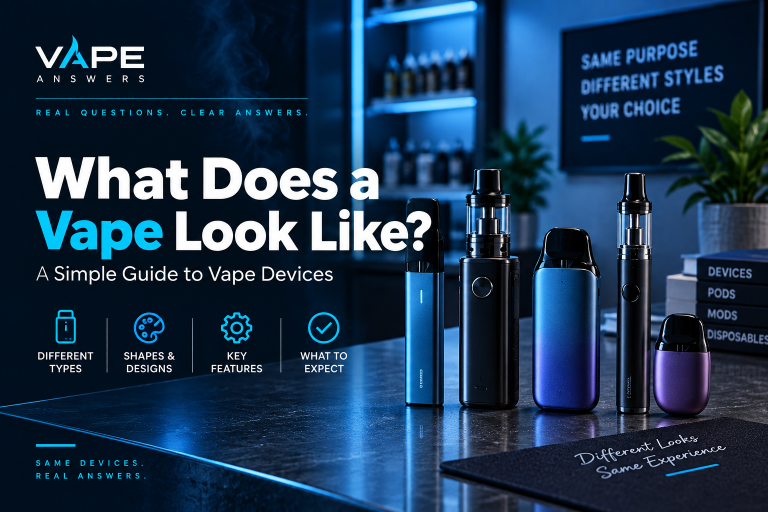
If you want to see how today’s devices differ from early cigarette-shaped models, read our guide to what a vape looks like.
2006 to 2007: Vaping Expands Beyond China
After its Chinese introduction, the modern e-cigarette moved into international markets.
Published historical reviews generally place European market entry around 2006 and U.S. market entry around 2007. Some sources differ slightly on individual imports and first sales, so these dates are better treated as market-entry periods rather than universal launch days.
Early products were frequently called “cigalikes” because they were designed to resemble cigarettes.
They generally had smaller batteries and limited liquid capacity compared with later devices.
The concept was recognizable, but the technology was still evolving rapidly.
Early 2010s: Vape Pens, Tanks and Mods
The answer to when did vapes come out also depends on which type of device you mean.
By the early 2010s, the industry was moving beyond small cigalikes. Larger batteries, refillable tanks and customizable hardware became increasingly common.
Vape pens provided a compact format that was visibly different from a cigarette. More advanced devices, often called mods, allowed greater control over features such as power and coil configuration.
Researchers sometimes divide e-cigarettes into different technological generations. These boundaries are not precise because products evolved continuously and terminology varies.
Still, the early 2010s represent an important shift toward the device styles many people now associate with vaping.
2015: Pod Systems and Nicotine Salts
JUUL launched in 2015 and became an important milestone in the development of compact pod-based vaping products.
Its small design and nicotine-salt formulation distinguished it from many earlier refillable systems. Nicotine salts subsequently became closely associated with compact pod systems and later many disposable products.
This period also coincided with growing public-health attention to vaping, particularly concerns about youth use and nicotine dependence.
People use vaping products for different reasons, and those motivations have changed as the market has evolved. Our separate guide explains why people vape in more detail.
When Did Disposable Vapes Come Out?
The question when did disposable vapes come out is more complicated than it first appears.
Disposable e-cigarettes are not entirely new. Some early first-generation cigalikes were themselves disposable.
What changed later was the scale and design of the disposable market.
Modern disposables with integrated batteries, prefilled e-liquid, multiple flavors and increasingly large advertised puff counts became particularly prominent from the late 2010s into the 2020s.
It is therefore misleading to assign the entire disposable category one recent invention date.
A better distinction is that disposable e-cigarettes existed during the earlier development of vaping, while the modern high-capacity disposable segment became prominent much later.
When Did Flavored and Nicotine Vapes Appear?
Flavoring also does not have one clean introduction date.
Gilbert’s 1963 patent discussed flavored air, although his device was not a modern commercial e-cigarette. Modern e-liquids later developed into numerous formulations as the market expanded.
Nicotine, meanwhile, was central to the commercially successful e-cigarette category that emerged in China in the early 2000s.
Later innovations changed how nicotine could be formulated and delivered. The growth of nicotine-salt pod systems in the mid-2010s was particularly significant.
Nicotine concentration and product rules now differ considerably between countries.
When Did Vapes Come Out in the US and UK?
For people researching when did vapes come out by country, historical reviews generally place European market entry around 2006 and U.S. market entry around 2007.
The UK was part of vaping’s early European expansion, although its regulatory framework developed substantially after e-cigarettes first appeared.
The U.S. market also evolved rapidly. One major regulatory milestone came in 2016 when the FDA finalized its Deeming Rule, extending federal tobacco-product authority to electronic nicotine delivery systems and other previously unregulated tobacco products.
These dates describe market and regulatory milestones. They do not mean every modern type of vape became available simultaneously.
2019: EVALI Changes the Vaping Debate
In 2019, the United States experienced an outbreak of e-cigarette, or vaping, product use-associated lung injury, commonly known as EVALI.
The outbreak became a major turning point in public discussion of vaping.
CDC investigations strongly linked vitamin E acetate to the outbreak, particularly in THC-containing vaping products. Many affected patients reported using THC-containing products, often obtained from informal sources.
However, it is inaccurate to say that illicit THC cartridges or vitamin E acetate definitively explained every case. CDC stated that evidence was insufficient to rule out contributions from other chemicals.
The outbreak increased scrutiny of vaping-product ingredients, informal supply chains and product safety.
How Vaping Regulation Developed in Canada
Canada’s approach to vaping has changed considerably since electronic cigarettes first appeared.
Federal rules now address areas including nicotine concentration, labelling, packaging, promotion and product safety. Provinces and territories can also impose additional requirements.
A major change occurred in 2021.
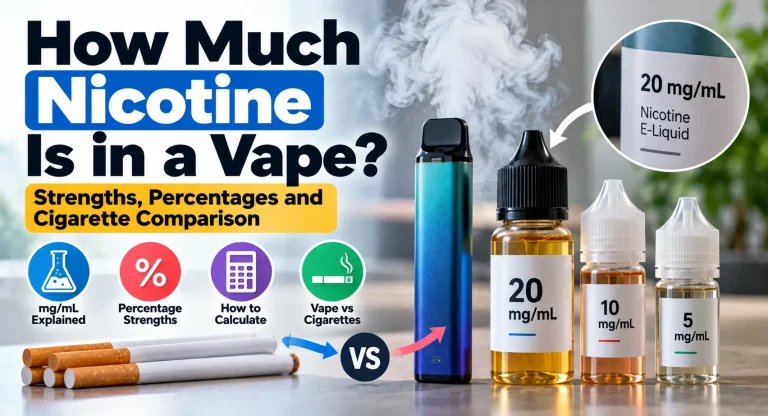
Canada’s Nicotine Concentration in Vaping Products Regulations established a maximum concentration of 20 mg/mL for vaping products covered by the regulations and intended for retail sale.
The regulations came into force on July 8, 2021.
This makes the original draft’s description of Canada as simply taking a “more liberal approach” inaccurate and too broad for a current 2026 article.
What Does the History of Vaping Tell Us?
Vaping did not emerge from one invention in isolation.
Robinson’s 1920s devices focused on medicinal vapor. Gilbert proposed a smokeless cigarette-like device in the 1960s. Hon Lik’s 2003 invention helped establish the modern commercial e-cigarette. Manufacturers later developed vape pens, refillable tanks, mods, pods and modern disposables.
This is why the answer to when did vapes come out depends partly on what the reader means by “vape.”
For an early electrical vaporizer, the timeline reaches the 1920s. For an important cigarette-like precursor, 1963 matters. For the commercially viable modern e-cigarette, 2003 to 2004 provides the clearest answer.
Frequently Asked Questions
When Did the First Vape Come Out?
The modern e-cigarette is generally dated to 2003, when Hon Lik developed his device in China. Commercial availability followed in China in 2004. Earlier vaporizer and smokeless-cigarette patents existed decades before it.
When Did Vape Pens Come Out?
Vape pens became increasingly prominent in the early 2010s as vaping moved beyond cigarette-shaped cigalikes toward larger batteries and refillable systems. There is no single launch date for the entire category.
When Did Vape Mods Come Out?
Mods became increasingly visible during the early to mid-2010s as devices offered larger batteries, refillable tanks and greater control over power and coil configurations.
When Did Vape Juice Come Out?
Liquid formulations were part of the modern e-cigarette from its early commercial era. E-liquid formulations diversified considerably as devices and the vaping market developed.
When Did THC Vapes Come Out?
Cannabis vaporizers and oil cartridges have a separate history from nicotine e-cigarettes. Cartridge-based cannabis vaping became increasingly prominent during the 2010s as hardware developed and regulated cannabis markets expanded in some jurisdictions.