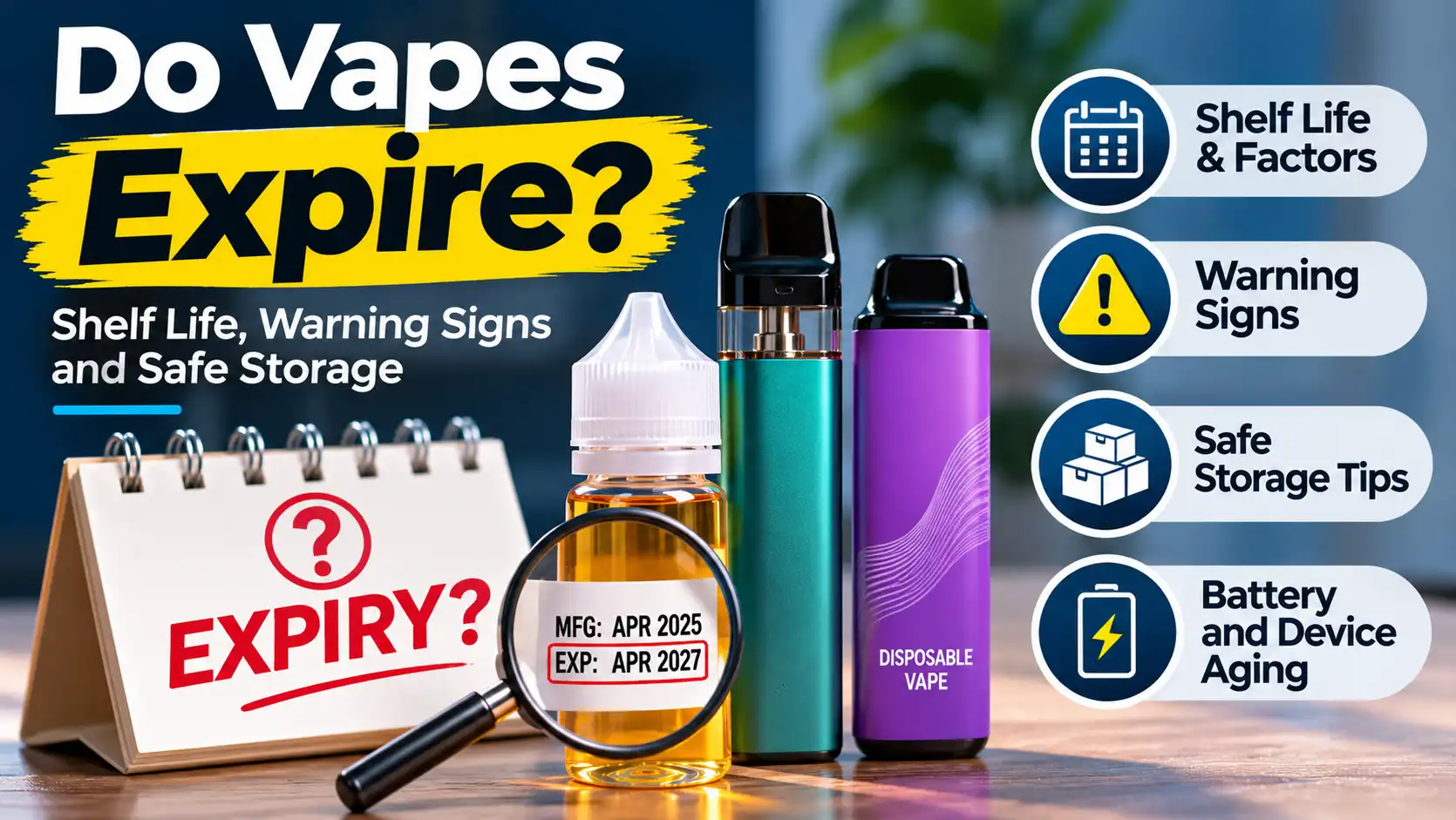
Do Vapes Expire? Shelf Life, Warning Signs and Safe Storage
Do vapes expire? Yes, vaping products can deteriorate over time, even when they remain unopened. E-liquid ingredients may change chemically, flavours can become less stable, batteries lose capacity, and seals or other components may deteriorate. However, there is no single expiration period that applies to every vape.
A disposable vape, a bottle of e-liquid and a refillable device age differently. Storage conditions, manufacturing quality and product formulation all influence their condition.
The most reliable approach is to check the manufacturer’s date and storage instructions, inspect the product for damage, and avoid using anything with suspicious changes or electrical problems.
Do Vapes Have Expiration Dates?
Some vaping products display an expiration date, best-before date, manufacturing date or batch code. Others have no clearly stated expiration date.
These markings serve different purposes:
| Label | What It Means |
|---|---|
| EXP or expiry | The manufacturer’s stated expiration date |
| Best before | A date associated with expected product quality |
| MFG | Manufacturing date |
| LOT or batch | Production information used for traceability |
A manufacturing date alone does not establish when a product expires.
Likewise, the absence of an expiration date does not prove that a product can be stored indefinitely.
Expiration vs Product Deterioration
An expiration date is a manufacturer’s product-specific claim. Deterioration is the physical or chemical change that can occur during storage or use.
For example, a sealed bottle may gradually change in colour or flavour composition, while an unused disposable may develop battery problems.
These changes do not necessarily occur at the same rate.
A product can also become unsuitable for use before its printed date if it has been damaged, overheated or stored improperly.
How Long Do Vapes Last Before They Expire?
There is no scientifically established universal shelf life covering all vaping products.
Different manufacturers use different ingredients, batteries, packaging materials and storage specifications.
The following table explains what determines the usable life of common products.
| Product Type | Main Aging Concerns | Best Way to Assess Shelf Life |
|---|---|---|
| Bottled e-liquid | Ingredient stability, oxidation and flavour changes | Manufacturer’s date and storage guidance |
| Disposable vape | E-liquid stability, battery condition and seals | Product-specific instructions and physical condition |
| Prefilled pod | Liquid stability, seals and internal components | Manufacturer’s expiry or replacement guidance |
| Refillable device | Battery aging, electrical contacts and component wear | Device condition and manufacturer instructions |
| Replaceable coil | Residue, wick damage and heating performance | Condition during use and replacement instructions |
You may encounter claims that e-liquid lasts one to two years or that disposables last six to eighteen months. These figures should not be treated as guaranteed expiration periods.
A product-specific shelf-life claim should ideally be supported by stability testing.
What Research Says About E-Liquid Aging
A 2025 study published in ACS Omega investigated flavouring chemicals in reference and commercial e-liquids stored under different conditions for up to 24 months.
Researchers observed that some flavourings changed substantially during storage. Reference liquids kept at room temperature with light exposure generally showed the poorest flavouring stability.
The study also found that cooler, darker storage conditions delayed the degradation of some compounds.
Importantly, this research did not establish a universal safe expiration date for vaping products.
A separate study on nicotine stability found that degradation depended on the chemical conditions tested. This reinforces why expiry estimates should be based on individual formulations rather than a fixed industry-wide number.
Do Disposable Vapes Expire?
Yes, unused disposable vapes can deteriorate while sitting in storage.
A disposable typically combines a battery, prefilled e-liquid reservoir, heating coil, wick and electronic components.
Because these parts are integrated, deterioration in one component can affect the performance of the entire device.
Battery Aging
Lithium-ion batteries gradually lose capacity over time, including during storage.
An older disposable may fail to activate, produce weak aerosol or stop working earlier than expected.
However, weak performance is not proof of expiration. Manufacturing defects, depleted batteries and other faults can produce similar symptoms.
E-Liquid and Wick Condition
The liquid inside a disposable can undergo chemical changes during storage.
The wick and reservoir may also be affected by leakage, damage or prolonged exposure to unsuitable conditions.
A burnt taste can indicate inadequate liquid reaching the coil or damage to the wick. It does not, by itself, establish how old the device is.
Seals and Leakage
A disposable’s internal seals help contain liquid and maintain the intended airflow path.
If the device leaks, has a damaged housing or shows signs of battery swelling, it should not be used.
For persistent leakage problems, see our guide to why a vape leaks.
Does Vape Juice Expire?
E-liquid does not spoil in exactly the same way as fresh food, but its chemical composition can change over time.
Most conventional nicotine e-liquids contain propylene glycol, vegetable glycerin, flavourings and nicotine.
These ingredients have different stability characteristics.
Nicotine Oxidation
Nicotine can undergo oxidation and other chemical reactions under certain conditions.
Some nicotine-containing liquids become darker during storage, although colour changes can have multiple causes.
Research has demonstrated that nicotine stability depends on factors such as formulation and exposure conditions.
A darker colour alone cannot establish how much nicotine has degraded or whether the liquid is safe to inhale.
Changes in Flavouring Chemicals
Flavouring compounds may degrade or react with other ingredients.
A liquid that originally had a distinct flavour may become weaker or smell different after prolonged storage.
Research has identified chemical changes in some flavourings over time, particularly under less favourable storage conditions.
These changes cannot be reliably measured through taste or smell alone.
PG and VG Stability
Propylene glycol and vegetable glycerin serve as the main carrier liquids in many e-liquids.
Although these ingredients are relatively stable under appropriate conditions, the complete formulation may still change through interactions involving nicotine, flavourings, packaging and environmental exposure.
The stability of individual ingredients should not be confused with the stability of the finished product.
What Are the Signs of Expired Vape Juice?
There is no single visual or sensory test that can confirm whether e-liquid has expired.
However, several changes justify checking the product and avoiding use when its condition is uncertain.
Unusual Colour Changes
Some nicotine liquids naturally darken over time.
Sudden or substantial discolouration, particularly alongside other unusual changes, warrants caution.
Colour alone cannot determine chemical safety.
Strange Smell
An unexpected chemical, sour or otherwise unusual odour may indicate a change in the formulation or contamination.
Do not deliberately inhale aerosol from questionable liquid to test whether it has gone bad.
Unexpected Separation or Cloudiness
Visible particles, unexplained cloudiness or unusual separation may indicate a formulation problem.
Some liquids have characteristics specific to their ingredients, so these signs must be assessed against the manufacturer’s description.
Do not assume shaking will correct an unknown stability or contamination problem.
Leaks or Damaged Packaging
A leaking bottle, broken seal or damaged cartridge can introduce additional uncertainty about storage and contamination.
If a product’s integrity is compromised, replacing it is more sensible than trying to restore it.
Important: Normal appearance does not guarantee chemical stability. Laboratory testing is needed to determine the concentration of specific degradation products or contaminants.
Do Vape Pods and Cartridges Expire?
Prefilled pods and cartridges contain liquid in a relatively small reservoir, often with an integrated heating element.
They can experience the same formulation changes as bottled e-liquid.
Their seals, contacts and internal components may also deteriorate.
A pod that has been stored for an extended period should be assessed using the manufacturer’s instructions and any available date markings.
If it leaks, is physically damaged or has an unusual appearance, avoid using it.
For more information about pod construction, read what a pod vape is.
Does Opening a Vape Affect Its Shelf Life?
Opening an e-liquid bottle changes its storage conditions.
Repeated opening can introduce air and increase opportunities for contamination.
The effect on stability depends on the formulation, container and storage environment.
A sealed bottle may be better protected from external contamination, but sealed packaging does not stop every chemical reaction.
For disposables and prefilled pods, beginning use also introduces repeated heating cycles and normal component wear.
Therefore, the time since opening and the total amount of use are different factors from the product’s original manufacturing date.
What Happens If You Use an Expired Vape?
Do vapes expire in a way that makes every old product immediately dangerous? Not necessarily. However, an expired or deteriorated product should not be assumed safe simply because it still activates.
Possible concerns include changes in chemical composition, unexpected performance, leakage and battery deterioration.
The available research does not support a universal claim that using e-liquid just beyond a printed date causes a particular illness.
It also does not establish that doing so is safe.
If a product is past its stated expiration date, follow the manufacturer’s guidance rather than relying on appearance or taste.
When to Stop Using a Vape Immediately
Stop using a device if you notice:
- Battery swelling or physical deformation
- Unusual overheating
- Hissing, smoke or other signs of battery failure
- A cracked or damaged battery housing
- Persistent leakage
- Unexplained electrical malfunction
- A strong burnt or abnormal chemical smell
If a battery appears to be failing, stop charging or operating the device. Do not puncture, crush or dismantle it.
Our article on vape battery explosions and safety explains these hazards in more detail.
How to Store Vapes and E-Liquid Properly
Storage cannot prevent all aging, but it can reduce avoidable exposure to conditions associated with deterioration.
Keep Products Away From Heat
Avoid leaving vapes in parked cars, direct sunlight or near heaters.
High temperatures can affect battery safety and the stability of liquid ingredients.
Limit Light Exposure
Store bottled e-liquid in its original packaging when possible.
Research indicates that light exposure can affect the stability of certain flavouring chemicals.
A dark storage location can help limit this exposure.
Keep Bottles Closed
Close e-liquid containers securely after use.
This helps limit contamination, spills and unnecessary exposure to air.
Follow Battery Storage Instructions
Battery-containing devices should be stored according to their manufacturer’s guidance.
Avoid excessive heat, physical damage and contact between exposed battery terminals and metal objects.
Do not place a damaged or swollen battery on charge.
Keep Nicotine Products Secure
Store nicotine-containing liquids and devices where children and pets cannot access them.
Nicotine exposure through swallowing or skin contact can be harmful, particularly to children.
Can You Fix an Expired Vape?
An expired product cannot be reliably restored to its original chemical condition through ordinary home troubleshooting.
Charging a rechargeable device may resolve a depleted battery, but it does not reverse battery aging or restore degraded liquid ingredients.
Similarly, cleaning accessible electrical contacts may resolve a connection problem, but it does not establish that an old pod or liquid remains suitable for use.
Avoid attempting to:
- Heat e-liquid to restore its original properties
- Open sealed disposables
- Puncture or manipulate batteries
- Add unknown ingredients to old liquid
- Force open cartridges not designed for refilling
These actions can introduce additional electrical, chemical or physical hazards.
How to Check Whether an Old Vape Should Be Used
Use this checklist before deciding what to do with a product that has been stored for a long time.
- Check the date: Look for an expiration, best-before or manufacturing date.
- Review manufacturer guidance: Follow any specified storage period or replacement instructions.
- Inspect the packaging: Look for broken seals, leakage or damage.
- Examine the device: Check for swelling, cracks or electrical problems.
- Assess the liquid: Note unexpected cloudiness, particles or other unusual changes without tasting it.
- Consider storage history: Prolonged heat exposure or unknown storage conditions increase uncertainty.
If the product is expired, damaged or questionable, do not try to verify its safety by vaping it.
For disposal, follow appropriate local electronic waste and battery collection procedures. Our guide explains how to dispose of a vape safely.
Frequently Asked Questions
Do Vapes Expire If They Are Never Used?
Yes. Unused vaping products can deteriorate during storage. Batteries age, liquid formulations may change, and seals can degrade. Being unopened does not guarantee indefinite usability.
How Long Does Vape Juice Last Unopened?
There is no universal shelf-life period. Follow the manufacturer’s stated expiration or best-before date, where provided. Formulation, packaging and storage conditions affect stability.
Can Expired Vape Juice Make You Sick?
The health effects of using a particular expired e-liquid cannot be determined from its age alone. Chemical changes may occur during storage, but appearance and smell cannot establish safety. Avoid using expired or suspicious products.
Can You Use a Disposable Vape After Its Expiration Date?
The safer approach is to follow the manufacturer’s expiration guidance. A device that still produces aerosol is not necessarily chemically or electrically sound.
Does Vape Juice Go Bad Faster in Heat?
Heat can accelerate certain chemical changes. Studies of nicotine and flavouring stability show that storage conditions can affect degradation, although the results depend on the formulation.
Is Dark Vape Juice Always Expired?
No. Colour changes can occur for several reasons, including reactions involving nicotine. Darkening alone does not confirm expiration or identify harmful chemical concentrations.