What Is a Live Resin Vape? A Complete Guide for Canada
If you are wondering what is a live resin vape, it is a cannabis vaping product filled with an extract generally made from cannabis that is frozen soon after harvest. Freezing the plant material helps preserve aromatic compounds that can be lost while cannabis is dried and cured.
Live resin cartridges are often chosen for their pronounced aroma and plant-specific flavour profile. However, the name does not guarantee a particular THC level, effect, purity or quality. Those details depend on the starting material, extraction process, formulation, hardware and product testing.
In Canada, live resin vape products fall within the cannabis-extract category. They should only be purchased through a provincially or territorially authorized cannabis retailer. This guide explains the terminology, production process, label information, differences between concentrates and practical safety considerations without relying on exaggerated potency or health claims.
What Is a Live Resin Vape?
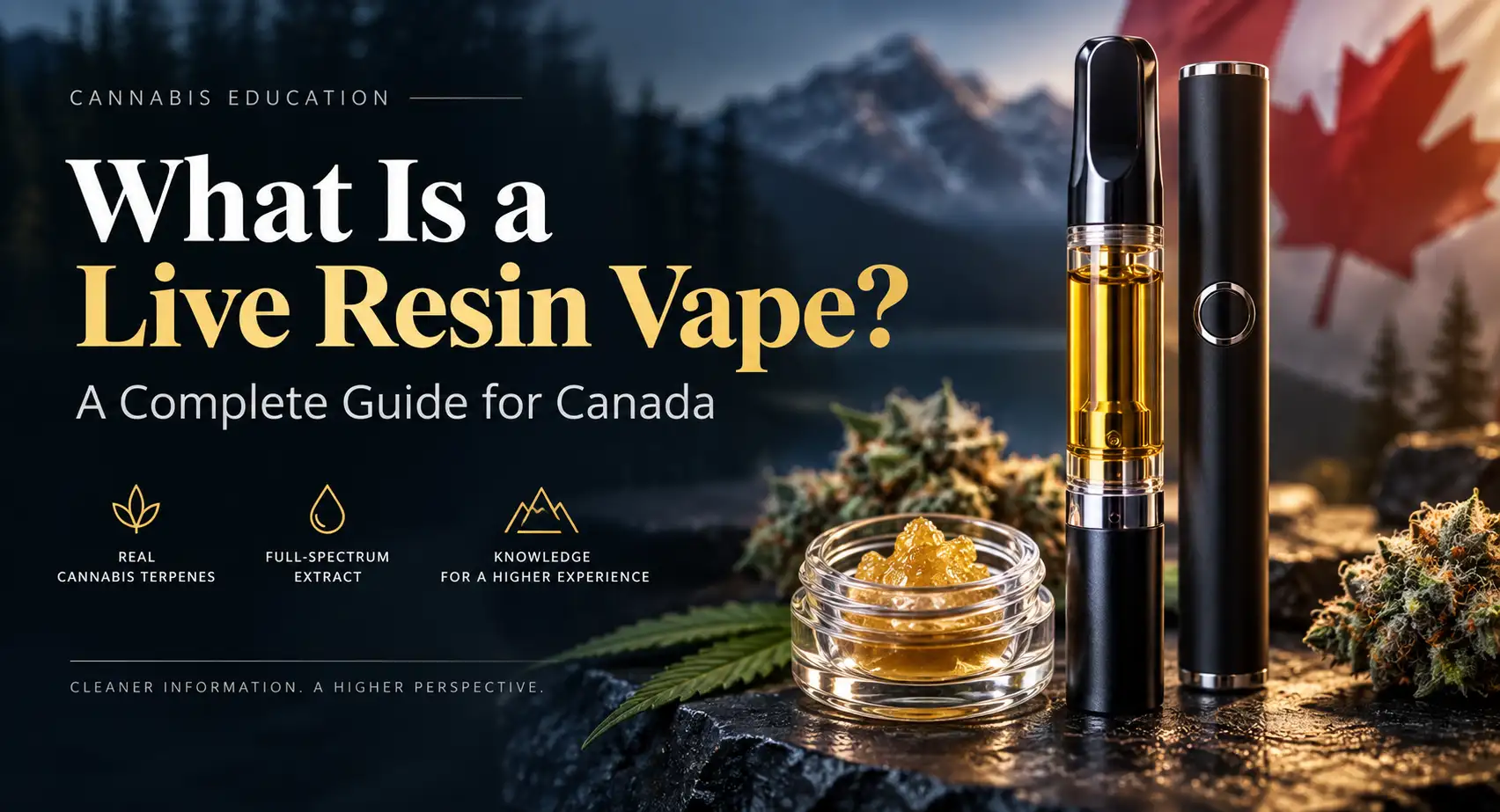
A live resin vape combines a battery-powered vaporizer with a cartridge or pod containing live resin cannabis extract. The heating element warms the extract and produces an aerosol that is inhaled through the mouthpiece.
The word “live” refers to the condition of the cannabis material before extraction. Instead of allowing the harvested plant to go through the usual drying and curing process, producers preserve it through rapid freezing. The frozen material is then processed under controlled conditions to extract cannabinoids, terpenes and other plant compounds.
When readers ask what is a live resin vape, the most important distinction is that it describes the starting material and extraction style, not one standardized recipe. Formulations differ among licensed producers, and the cartridge may contain other permitted ingredients listed on its packaging.
A live resin cartridge is also different from a nicotine vape. Cannabis oil should never be added to a nicotine pod, disposable or e-liquid tank unless the device manufacturer explicitly designed that hardware for the substance.
What Does “Live Resin” Mean?
Live resin is a cannabis concentrate commonly produced from fresh or fresh-frozen cannabis using a solvent-based extraction process. Its defining feature is the effort to preserve compounds present around harvest time rather than beginning with fully dried and cured flower.
Terpenes are volatile aromatic compounds. Heat, oxygen, handling and time can change a plant’s terpene profile, so freezing the harvested material can help reduce some of the changes associated with drying and curing.
This does not mean the frozen plant remains literally alive. “Live” is an industry term describing how the source material is preserved before extraction.
It is also important not to assume that every product carrying the term has an identical composition. A licensed product label provides more reliable information than broad terms such as “premium,” “full-spectrum” or “strain authentic.”
How Is Live Resin Made?
Commercial live resin production requires controlled equipment, appropriate licensing and professional testing. It is not a safe home-extraction project.
Although individual production methods vary, the process generally follows these stages.
Harvesting and Freezing
Cannabis is harvested and placed into controlled cold storage soon afterward. Producers may use industrial freezers or another rapid-freezing system appropriate for their facility.
The purpose is to preserve the freshly harvested material without first putting it through the full drying and curing process.
Extraction
The frozen plant material is processed in specialized closed-loop equipment. Hydrocarbon solvents such as butane, propane or a blend may be used to separate cannabinoids and aromatic compounds from the plant material.
Exact solvents and procedures vary by producer. The fact that live resin is generally solvent-extracted is one of the main differences between live resin and live rosin.
Solvent Removal and Refinement
After extraction, the concentrate is processed to remove residual solvent and reach the consistency required for its intended format.
A concentrate sold in a vape cartridge must also work with the cartridge’s heating element and oil-flow design. Producers may formulate the extract differently depending on the hardware.
Product Testing and Packaging
Legal cannabis extracts in Canada are subject to federal requirements governing production, composition, packaging and labelling. The finished package provides information such as THC and CBD quantities, ingredients, lot details and standardized cannabis symbols where required.
Consumers cannot determine residual solvents, contaminants or cannabinoid content by colour, smell or thickness alone. This is one reason the legal source and original packaging matter.
What Is Inside a Live Resin Cartridge?
A live resin cartridge normally contains a cannabis extract with cannabinoids and aromatic compounds derived from the source material. The exact formulation must be checked on the product label.
Cannabinoids
The most prominent cannabinoid may be THC, although CBD and other cannabinoids can also be present. The amount varies by product.
Do not assume a live resin cart contains less or more THC than another type of cartridge. Compare the THC and CBD information printed on the package rather than relying on the extraction category.
Terpenes
Terpenes contribute to the product’s aroma and flavour. Live resin is generally associated with a more noticeable plant-derived terpene profile because of the way its starting material is preserved.
A stronger aroma does not establish purity, potency or a specific effect. Terpene levels and composition can differ substantially between products.
Other Listed Ingredients
A cartridge may contain additional permitted ingredients or a blend of cannabis extracts. Read the complete ingredient list.
Terms such as “live resin,” “live terpene,” “liquid diamonds” and “distillate with live resin” do not necessarily describe the same formulation. If a product combines distillate with live resin or added terpenes, the label should be read as a whole rather than judging it by the largest words on the front.
Is Live Resin Always Full-Spectrum?
No. Live resin is often marketed as full-spectrum, but the two terms are not automatically interchangeable.
“Full-spectrum” is generally used to suggest that an extract retains a broad range of compounds from the plant. There is no reason to assume every live resin cartridge preserves the same range or proportions. Processing and formulation can alter the finished profile.
The more defensible approach is to check the cannabinoid information, terpene details when available, ingredients and producer documentation.
Live Resin vs Distillate
The main difference between live resin vs distillate is the objective of the extraction and refinement process. Live resin generally focuses on preserving more of the source plant’s aromatic profile, while distillation produces a highly refined cannabinoid ingredient.
| Comparison Point | Live Resin | Distillate |
|---|---|---|
| Starting material | Commonly fresh-frozen cannabis | Can be produced from different cannabis inputs |
| Processing goal | Preserve a broader plant-derived profile | Refine and concentrate selected cannabinoids |
| Aroma and flavour | Often more plant-forward and cultivar-specific | Usually neutral before terpenes or flavours are added |
| THC content | Varies by product | Often highly concentrated, but varies |
| Consistency | Depends on formulation | Generally consistent and refined |
| Price | Often higher | Frequently more economical |
| Best comparison method | Label, ingredients and testing information | Label, ingredients and testing information |
Distillate can contain a higher THC percentage, but a larger number does not prove that a product is better or that every person will experience it in the same way.
Statements such as “live resin always hits harder” or “distillate produces an empty high” are subjective and should not be presented as universal facts.
Understanding what is a live resin vape is easier when THC percentage and extract type are treated as separate details. One describes cannabinoid concentration, while the other describes how the concentrate was produced and formulated.
Live Resin vs Rosin
The key difference between live resin vs rosin is the extraction method.
Live resin is generally produced using a solvent-based process. Live rosin is produced mechanically, commonly using heat and pressure on fresh-frozen material that has first been processed into hash.
| Comparison Point | Live Resin | Live Rosin |
|---|---|---|
| Extraction method | Typically solvent-based | Solventless mechanical separation |
| Starting material | Fresh or fresh-frozen cannabis | Usually fresh-frozen material processed into hash |
| Processing | Closed-loop extraction and solvent removal | Hash production followed by heat and pressure |
| Aroma | Often pronounced | Often pronounced |
| Availability | Common in several extract formats | Can be less widely available |
| Cost | Varies, often below live rosin | Frequently priced higher due to production demands |
Calling rosin “cleaner” simply because it is solventless is too broad. Product quality also depends on the source material, facility, processing controls, storage and testing.
Neither category is automatically safer, stronger or better for every person.
How Is Live Resin Different From Cured Resin?
Cured resin is generally produced from cannabis that has been dried and cured before extraction. Live resin begins with material preserved near harvest through freezing.
The difference in starting material can produce a different aromatic and flavour profile. Curing changes the plant over time, while freezing aims to retain more of its harvest-stage characteristics.
Both products can vary significantly. “Live” should not automatically be interpreted as fresh, safer or higher quality in every respect.
Does Live Resin Get You Higher Than Distillate?
Not necessarily. Distillate may contain more THC, while live resin may contain a broader mix of plant compounds. Neither fact predicts one universal result.
Cannabis effects vary according to:
- THC and CBD quantities
- Amount inhaled
- Frequency of cannabis use
- Individual tolerance
- Product formulation
- Previous experience
- Other substances or medications
- Personal health factors
Claims that terpenes guarantee a particular mood or that live resin always creates a more balanced effect go beyond what a label can establish. Anyone concerned about cannabis effects, medication interactions or mental health should consult a qualified health professional.
Health Canada warns that higher-THC cannabis products can increase risks including anxiety, dependence and other mental-health effects, particularly with frequent use.
How Do You Read a Live Resin Vape Label?
The label gives more useful purchasing information than the colour or thickness of the oil.
Check these details:
- THC and CBD quantities: Review both the amount as sold and the total after activation where displayed.
- Package size: Cartridge quantities are commonly shown in grams.
- Ingredients: Confirm whether the product is live resin alone or a formulated blend.
- Producer information: Look for the licensed processor’s name and contact details.
- Lot number: This identifies the production batch.
- Packaging date: Useful for understanding product age.
- Warning statements: Read them before use.
- Standardized cannabis symbol: Required on qualifying THC-containing cannabis products.
- Excise stamp: Legal products generally carry the applicable provincial or territorial cannabis excise stamp.
- Device requirements: Check whether the cartridge needs a separate compatible battery.
Health Canada classifies cannabis vape liquids, resin, rosin, wax and similar products as cannabis extracts and provides guidance for reading regulated cannabis labels.
Are Live Resin Vapes Legal in Canada?
Live resin vape products can be sold legally in Canada when they comply with federal requirements and are distributed through the authorized system. Provincial and territorial rules determine legal purchasing age, permitted retailers, possession and where cannabis may be consumed.
Understanding what is a live resin vape in Canada therefore requires more than checking the product format. Buyers must also check the rules in their province or territory.
Purchase legal cannabis only from a provincially or territorially authorized retailer. Avoid products offered without compliant packaging, required label information, lot identification or an applicable excise stamp.
Quality Vapes is not presented here as a cannabis retailer, and this guide should not direct readers to buy live resin cartridges from a nicotine-vape store.
Are Live Resin Vapes Safe?
No inhaled cannabis product should be described as completely safe. A regulated product reduces some risks associated with unknown or illicit products, but it does not make cannabis vaping risk-free.
When asking what is a live resin vape from a safety perspective, consider both the cannabis extract and the electronic hardware.
Potential concerns include:
- High THC exposure
- Dependence
- Anxiety or other unwanted effects
- Impaired attention and reaction time
- Respiratory irritation
- Unknown ingredients in illicit products
- Damaged or incompatible hardware
- Battery overheating
- Accidental exposure involving children or pets
Health Canada advises monitoring for symptoms such as coughing, shortness of breath or chest pain and seeking medical attention if there are health concerns related to vaping.
Do not drive or operate machinery after using cannabis. Keep cannabis products secured in their original child-resistant packaging.
Cartridge and Battery Compatibility
Many cannabis cartridges use a 510-thread connection, but the thread alone does not guarantee complete compatibility. Cartridge resistance, airflow, voltage requirements and battery design can differ.
Follow the cartridge producer’s and battery manufacturer’s instructions. Do not assume that one voltage range is suitable for every live resin product.
The original draft’s universal 2.4V to 3.2V recommendation should not be published without product-specific evidence. Excessive heat may affect flavour and cartridge performance, while insufficient power may prevent normal operation.
For general hardware precautions, read the vape battery safety guide. Quality Vapes also lists dry herb vaporizers and compatible vaporizer hardware, but dry-herb devices and oil cartridges are not automatically interchangeable.
How Should a Live Resin Cartridge Be Stored?
Storage instructions on the original package should take priority. General precautions include:
- Keep the cartridge in its original packaging when practical.
- Store it away from direct sunlight and excessive heat.
- Keep it secured from children and pets.
- Avoid leaving it inside a hot vehicle.
- Protect it from physical damage.
- Keep the connection area clean and dry.
- Do not use a cartridge that is cracked, leaking or otherwise damaged.
- Do not transfer the contents into unsuitable hardware.
Changes in colour or viscosity do not provide a reliable home test for safety. If the product appears damaged or behaves abnormally, stop using it and contact the licensed retailer or producer identified on the packaging.
Can You Refill a Live Resin Cartridge?
A cartridge should not be refilled unless its manufacturer specifically designed it for refilling and provides instructions for doing so. Many prefilled cannabis cartridges are intended to be replaced when empty.
Opening or modifying a sealed cartridge can cause contamination, leakage, incorrect heating and damage to the hardware. It can also make it impossible to know exactly what substance is being inhaled.
Never add nicotine e-liquid, household oils, essential oils or an unidentified concentrate to a cannabis cartridge.
How Long Does a Live Resin Cartridge Last?
There is no standard number of days or puffs. Cartridge size, product viscosity, hardware output, draw duration and frequency of use all affect consumption.
The original draft’s claim that a one-gram cartridge normally lasts from a few days to a couple of weeks is too broad to be reliable. It could also encourage readers to treat someone else’s consumption pattern as a target.
A more useful approach is to monitor the cartridge level and follow the product instructions. Stop using it when empty, damaged, leaking or producing abnormal performance.
Live Resin Vape Advantages and Limitations
A neutral comparison is more useful than describing the product as automatically superior.
| Potential Advantages | Important Limitations |
|---|---|
| Pronounced cannabis-derived aroma | Stronger smell may reduce discretion |
| Profile associated with fresh-frozen material | Usually costs more than basic distillate |
| Convenient cartridge format | Requires compatible hardware |
| Labelled cannabinoid information on legal products | THC concentration may still be high |
| No burning of dried flower | Vaping still carries health risks |
| Variety of extract formulations | “Live resin” does not guarantee full-spectrum quality |
Whether the format is suitable depends on the legal product, its label, the hardware and the individual’s circumstances. Marketing language should never replace those checks.
Is a Live Resin Vape Worth Considering?
The answer depends on what information matters to the buyer. A live resin product may appeal to someone comparing cannabis extracts by aroma, flavour profile and processing method. It is not automatically stronger, cleaner, safer or more effective than distillate or rosin.
The clearest answer to what is a live resin vape is that it is a cartridge or disposable containing a cannabis extract generally made from fresh-frozen plant material. Its actual composition and THC level must be confirmed through the legal product label.
Compare regulated products using their ingredients, THC and CBD quantities, package information and hardware requirements. Avoid unlabelled cartridges and exaggerated promises about potency, mood or health benefits.
Frequently Asked Questions
What is the difference between live resin and distillate?
Live resin generally begins with fresh-frozen cannabis and aims to preserve more of the source plant’s aromatic profile. Distillate undergoes additional refinement to concentrate selected cannabinoids. Distillate may have a higher THC percentage, but extract type alone does not determine quality, safety or how every person will experience the product.
Is live resin stronger than a regular vape cartridge?
Not necessarily. The strength of a cannabis cartridge depends primarily on its labelled THC and CBD quantities, formulation and amount used. Some distillate cartridges contain more THC than live resin products. Descriptions such as fuller, smoother or stronger are subjective and should not replace the information on the regulated package.
Is live resin the same as live rosin?
No. Live resin is generally produced through solvent-based extraction of fresh-frozen cannabis. Live rosin is made without extraction solvents, commonly by pressing hash produced from fresh-frozen material. Both can retain pronounced aromatic characteristics, but their processing methods, formulation, availability and price can differ.
Does a live resin vape smell like cannabis?
It can have a noticeable cannabis-like aroma because the extract may retain a pronounced terpene profile. The strength varies by product, hardware and amount used. It should not be considered odourless or discreet simply because it comes in a cartridge rather than as dried flower.
Can any 510 battery use a live resin cartridge?
No. A shared 510-thread connection does not guarantee that every battery and cartridge are suitable together. Check the cartridge producer’s voltage, resistance and compatibility instructions before use. Avoid using damaged hardware or forcing a cartridge onto a battery that does not connect properly.